Controversy over a plan to revitalize the Chesapeake & Ohio (C&O) Canal in Washington, D.C. has some questioning whether the High Line in New York City is the best model for the adaptive reuse of public space.



David Alpert reports from Georgetown in Washington, D.C., where a plan to overhaul the Chesapeake & Ohio (C&O) Canal has been questioned as an "ill-advised attempt to recreate New York’s wildly successful [sic] 'High Line' park."
"The National Park Service, which controls the canal, has been working with the Georgetown Heritage, the DC government, and Georgetown’s Business Improvement District to create a new plan for the canal," according to Alpert. "Georgetown Heritage, a nonprofit which advocates for the canal’s preservation, calls it 'unlocking the potential' of the canal, which opened in 1831."
A local organization by the name of the Committee of 100 on the Federal City, committed to, in its own words, sustaining and safeguarding the fundamental values of the L’Enfant and McMillan Plans, is leading the criticism of the National Park Service plan.
Among the proposals for the C&O Canal, are plans to return mule-drawn boats on the canal and add more access points to the canal, among other ideas.
FULL STORY: Plans for Georgetown’s C&O Canal meet misanthropic planning attitudes

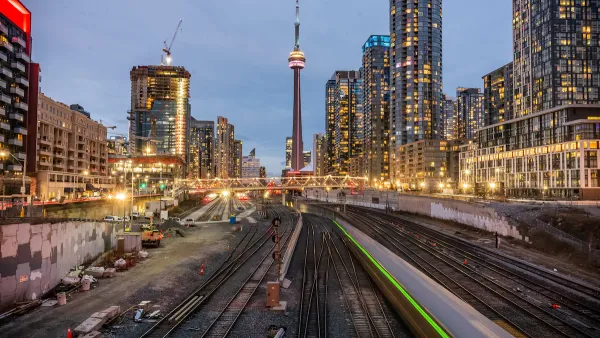
Toronto to Explore Potential High Line-Style Park
City staff will study options for transforming a defunct rail corridor into a linear park.

Tax Abatements Could Spur Adaptive Reuse in Washington, D.C.
Faced with commercial vacancies around 11 percent and the prospect of new office supply coming online soon, D.C. stakeholders are pushing for a bill that would provide incentives for conversions of office buildings into residential units.

Toward a System of Adaptive Reuse Feasibility
A relative lack of conversions from office to residential—the adaptive reuse model driving the housing market in many urban areas—makes the Washington, D.C. region a perfect place to study the factors that make or break an adaptive reuse proposal.

Planetizen Federal Action Tracker
A weekly monitor of how Trump’s orders and actions are impacting planners and planning in America.

The state-sanctioned urbicide of Austin
People don’t kill cities. Freeways do.

US to reduce Colorado River water deliveries to Mexico
A new Colorado Treaty amendment reduces Mexico’s Colorado River water allocation by 250,000 acre feet.

5 New England states march closer to 800 megawatt wind energy project
Securing federal approval for the project may be complicated under the Trump administration, which has historically been hostile towards domestic wind power.

Baltimore to break ground on $50 million Transit Priority Project
The project will bring faster bus trips, safer streets and better bike connections to Baltimore.

Airbnb launches $250 million 'last-dollar financing' housing accelerator, makes first investment in Austin
The company will put $6.4 million towards affordable housing development in Texas’ capital.

FREE Course: Walkable City 1: Why Walkability?
After describing his path towards focusing on walkability as the essence of good planning, Jeff Speck marches through his five principal reasons for making more walkable places.
Reinventing Malls: Planning Alchemy—Turning Gray Fields Into Gold
The course focuses on the opportunities and imperatives that shape reinvention of mall sites.

Eagle County Government
Harvard University Graduate School of Design
Nashville Planning Department
The Architects Foundation
University of Cincinnati Online
The Pocatello Development Authority
The Urban Renewal Agency of the City of Pocatello
Journal of the American Planning Association