More people than ever are traveling, but cities around the world are struggling to keep up. A new declaration aims to balance the benefits and challenges of tourism.


Leaders from major cities around the world recently met in Lisbon and adoptedthe Lisbon Declaration on Cities for All, an agenda to help cities better manage tourism. "The declaration highlighted the contribution of tourism to cities’ economies but it also acknowledged some of the challenges, including pressure on infrastructure, relationships between visitors and locals and fair working conditions," writes Catarina Demony.
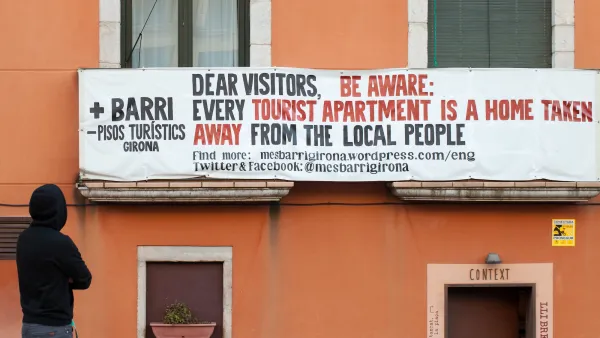
Low-fare airlines and a boom in new accommodation options like Airbnb are making it easier for greater numbers of people to travel. But for popular tourist destinations, the result has been higher living costs, particularly related to housing, and the displacement of residents.
The mayors and officials who signed on to the declaration came from 16 cities, including Lisbon, Barcelona, Paris, São Paulo, and Seoul, reports Demony. In Lisbon, city officials are especially concerned about rising housing costs and the effects of increased levels of tourism on historical areas.
FULL STORY: Mayors of the world unite to tackle challenges of mass tourism

Spain Fines Airbnb $75 Million After Crackdown on Unlicensed Rentals
The government took action after residents in tourist centers protested, blaming tourist rentals for a growing housing crisis.
Spain Moves to Ban 66,000 Airbnbs
The national government is requiring the short-term rental operator to remove thousands of illegal listings from its site as part of an effort to stem a growing housing crisis.

Short-term rental licenses grew by 46% near Obama Center as affordable homes disappear
The Chicago ward where the Obama library is located is one of the only parts of the city to see an increase in STR licenses.

Planetizen Federal Action Tracker
A weekly monitor of how Trump’s orders and actions are impacting planners and planning in America.

The state-sanctioned urbicide of Austin
People don’t kill cities. Freeways do.

US to reduce Colorado River water deliveries to Mexico
A new Colorado Treaty amendment reduces Mexico’s Colorado River water allocation by 250,000 acre feet.

5 New England states march closer to 800 megawatt wind energy project
Securing federal approval for the project may be complicated under the Trump administration, which has historically been hostile towards domestic wind power.

Baltimore to break ground on $50 million Transit Priority Project
The project will bring faster bus trips, safer streets and better bike connections to Baltimore.

Airbnb launches $250 million 'last-dollar financing' housing accelerator, makes first investment in Austin
The company will put $6.4 million towards affordable housing development in Texas’ capital.

FREE Course: Walkable City 1: Why Walkability?
After describing his path towards focusing on walkability as the essence of good planning, Jeff Speck marches through his five principal reasons for making more walkable places.
Reinventing Malls: Planning Alchemy—Turning Gray Fields Into Gold
The course focuses on the opportunities and imperatives that shape reinvention of mall sites.

Eagle County Government
Harvard University Graduate School of Design
Nashville Planning Department
The Architects Foundation
University of Cincinnati Online
The Pocatello Development Authority
The Urban Renewal Agency of the City of Pocatello
Journal of the American Planning Association