Originally approved by 52 percent of voters in May 2016, the 4-year, 10 cents per gallon city gas tax has outperformed revenue projections. Funds are split between road maintenance and bike and pedestrian projects.


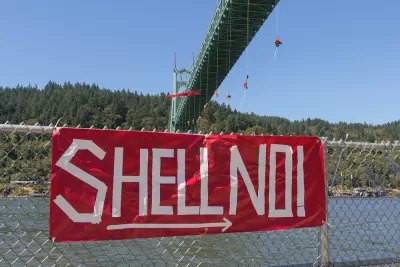
"Portland Commissioner Chloe Eudaly said [March 20] that she plans to send a 10-cent gas tax back to voters in May 2020," reported Andrew Theen for The Oregonian. Eudaly, who also oversees the Portland Bureau of Transportation, made the announcement during the City Council’s first annual briefing on the 2016 voter-approved gas tax.
The announcement comes as the city is just hitting the halfway mark on its four-year gas tax, but transportation officials say the funding scheme has already and consistently overperformed the city’s initial revenue projections... Portland has collected $39 million in gas tax money so far, $7 million more than initially estimated.
The majority of the gas tax revenue, 56 percent, goes to street maintenance projects while the remainder is spent on pedestrian or bicycle safety.
Constitutional restrictions prevent revenue from being spent on public transit, emailed Elliot Njus, commuting and transportation reporter for The Oregonian.
The May 17, 2016, Measure 26-173 Motor Vehicles Fuels Tax (also see Ballotpedia: Temporary fuel tax referendum: Resolution 37185) was sponsored by then-Portland Transportation Commissioner Steve Novick, "who was running for re-election to his council seat on the same ballot," reported Njus on May 18, 2016.
"If that passes, I'm going to be ecstatic," Novick said earlier Tuesday night, as his own race appeared headed to a runoff election. "If I had to choose between the gas tax and going to November myself, I would choose the gas tax anytime."
Sadly for Novick, the choice was made for him in the following November election, but no doubt he is pleased that his successor, Eudaly, is continuing his legacy in having city motorists pay for street maintenance and bike and pedestrian safety and infrastructure improvements. Oregon cyclists also directly pay for the latter when they purchase bicycles and pay the nation's first and only state bicycle excise tax, thanks to the passage of HB 2017.
Portland's truck tax
Theen also reports on the Portland Heavy Vehicle Use Tax that applies to companies that pay the Oregon Weight-Mile Tax. It was approved by the City Council on May 11, 2016, to show voters that heavy trucks, which disproportionately contribute to road wear, would also pay toward road upkeep. Despite the "fuel tax" name in the ballot measure, only gasoline is taxed.
Revenues are lower than initially projected after the city council bowed to industry pressure, resulting in fewer vehicles paying the fee, reported Gordon R. Friedman for The Oregonian on Nov. 27, 2018.
Related in Planetizen:
-
Portland's 10-Cent Gas Tax Gets to Work, September 20, 2016Portland isn’t collecting a gas tax approved by voters in May yet, but the city is already finding a way to spend the money.
FULL STORY: Portland will send 10-cent gas tax back to voters in May 2020

Portland Gas Tax Renewal Up to Voters
Without the extension, the city’s transportation bureau faces a $32 million shortfall.
A Game-Changing Bike and Pedestrian Bridge Opens in Portland
A bridge in the works since the 1970s marks significant progress for active transportation in Portland, Oregon.
Audit Faults Oregon DOT for Lack of Public Engagement
Faulted for lack of attention to pedestrian and bike advocates, the Oregon Department of Transportation will soon have opportunities to redeem itself.

The state-sanctioned urbicide of Austin
People don’t kill cities. Freeways do.

US to reduce Colorado River water deliveries to Mexico
A new Colorado Treaty amendment reduces Mexico’s Colorado River water allocation by 250,000 acre feet.

New Jersey’s second-largest city bans standalone data centers
Jersey City will continue to allow co-location facilities, such as those meant for research institutions that store their own data.

Amtrak not solely to blame for New Jersey commuter rail's unreliability, report finds
A new study from the Garden State Initiative found that NJ Transit’s budget grew 20% across a 4 year period, but reliability declined significantly over the same period.

EPA erases limits on planet-warming pollution from power plants
Under Monday’s plan, power plants would still have some limits on how much mercury, arsenic and other contaminants they can emit.

Phoenix announces new on-demand transit service, more frequent RAPID buses
Both new services will launch in October, and are part of Phoenix's Project Effective Access Solutions for Easing Congestion.

FREE Course: Walkable City 1: Why Walkability?
After describing his path towards focusing on walkability as the essence of good planning, Jeff Speck marches through his five principal reasons for making more walkable places.
Reinventing Malls: Planning Alchemy—Turning Gray Fields Into Gold
The course focuses on the opportunities and imperatives that shape reinvention of mall sites.

Eagle County Government
Harvard University Graduate School of Design
Nashville Planning Department
The Architects Foundation
University of Cincinnati Online
The Pocatello Development Authority
The Urban Renewal Agency of the City of Pocatello
Journal of the American Planning Association