New intercity bus transit service is in the works in King County, Washington.


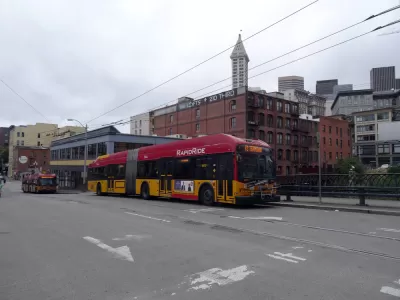
"King County Metro has begun planning for a RapidRide corridor in Southeast King County, known as the RapidRide I Line," reports Stephen Fesler.
The corridor, laid out in the Metro Connects long-range plan, will run from Renton to Auburn, passing through Kent along the way.
System planners are promising better frequencies and faster trips, but Fesler makes the case that those benefits will be hard to deliver in the southeastern parts of the county. "Traditionally, pull-in stops have been created instead of in-lane bus stops. This creates an unsafe weaving for bus operators and often means delay to buses when trying to re-enter traffic lanes. Getting cities to allow in-lane bus stops may be a big lift. Installing transit signal priority, queue jumps, and bus lanes may also be difficult techniques to convince local traffic engineers and policymakers on."
As noted by Fesler, the planning process for the new RapidRide will consider how other local routes and dial-a-ride systems integrate with the new line.
Read the full story: Metro Begins RapidRide I Line Planning, Targets 2023 Opening

Suburban Detroit Achieves Long-Awaited Bus Service Expansion
Novi and Bloomfield Hills in Southeast Michigan will have transit service for the first time in 28 years.

The Bus Revolution Has Been Revised in Philadelphia
The Southeastern Pennsylvania Transportation Authority went back to the drawing board with its Bus Revolution system redesign after an initial round of feedback completed earlier this year.
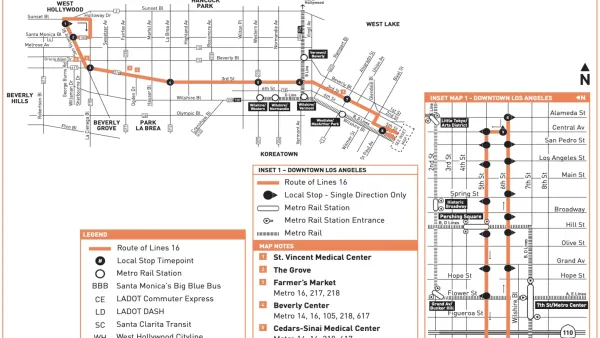
Popular L.A. Bus Line to Replace Schedule With ‘Headway-Based Operations’
Los Angeles’ 16 bus, which cuts across the city on Third Street through some of the city’s densest neighborhoods, will experiment with a new approach to service design.

Planetizen Federal Action Tracker
A weekly monitor of how Trump’s orders and actions are impacting planners and planning in America.

California plans to bury El Niño’s downpour
If the state plays its cards right, it may be able to store a billion acre-feet of El Niño’s water in aquifers.

Chicago breaks ground on $3 billion megadevelopment
The new neighborhood, titled Foundry Park, will one day host 3,700 residences.

California High-Speed Rail Authority CEO resigns after $600,000 scandal
Under Ian Choudri, the authority used taxpayer dollars to fund first class flights and trips to nightclubs.

Want to study the Missouri River? Soon, you may need unanimous approval from 10 states
Legislation would require 10 governors’ permission to study or build projects moving water outside the basin.

Desperate measures: Advocates weigh draining Lake Powell to fill Colorado River
Draining the reservoir could reduce evaporation losses by a couple hundred thousand acre-feet.

FREE Course: Walkable City 1: Why Walkability?
After describing his path towards focusing on walkability as the essence of good planning, Jeff Speck marches through his five principal reasons for making more walkable places.
Reinventing Malls: Planning Alchemy—Turning Gray Fields Into Gold
The course focuses on the opportunities and imperatives that shape reinvention of mall sites.

City of Rosemead
Rutgers University, Edward J. Bloustein School of Planning and Public Policy
One Hundred Miles
Hunter College, City University of New York (CUNY)
The Architects Foundation
University of Cincinnati Online
City of Cambridge
Montrose County
The Pocatello Development Authority