Many delivery services have come under scrutiny for questionable labor practices. Grub Street follows a Postmates delivery worker through one night to understand the nature of the work and assess the earnings.


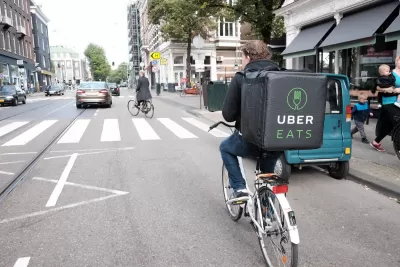
Delivery services represent a growing industry attracting investment and, in some cases, receiving multi-billion dollar valuations, but critics have questioned the labor practices of the industry. "DoorDash, Postmates, Grubhub, and Uber Eats have all been embroiled in legal fights over wage theft and, in just the last two weeks, DoorDash, Instacart, and Amazon’s on-demand delivery service, Flex, have come under fire for using customer tips to cover the minimum fees that these companies promise their workers," Clint Rainey writes for Grub Street.
Rainey followed Krista Gay on an evening of work to see what the job was like on the ground. Gay spent a lot of her time waiting. "Gay’s chicken Caesar isn’t ready yet, but she’s practically on a first-name basis with the staff — a couple of words and nods is all it takes to get the order thrown together quickly," Rainey writes. Sadly, Gay was only tipped by one of the four deliveries she went on. This is pretty typical for Gay: she finds that after a few months working for Postmates, she gets tipped on about a quarter of her deliveries. "All in, Gay yielded $16.62 for an hour and a half of work, not even clearing New York’s $15 minimum wage for food-service workers," Rainey writes.
Read the full story: A Night in the Life of a Postmates Delivery Worker
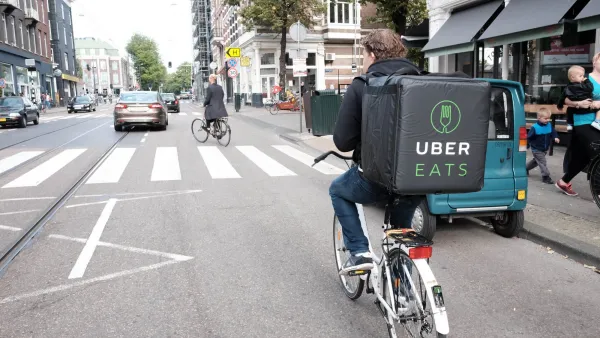
Uber Tests Subscription Bundling of its Services
Uber is selling a package that includes its delivery service, bikes, scooters, and a discount on ride hailing for one price.
Santa Fe Becomes First US City to Tie Minimum Wage to Rent
The city’s minimum wage increases will be tied to the Consumer Price Index and local market housing costs.

DoorDash Plans to Deploy Delivery Robots in Suburban Bike Lanes
A new generation of delivery robot is designed to make longer trips and could compete with cyclists for bike lane space.

Planetizen Federal Action Tracker
A weekly monitor of how Trump’s orders and actions are impacting planners and planning in America.

California plans to bury El Niño’s downpour
If the state plays its cards right, it may be able to store a billion acre-feet of El Niño’s water in aquifers.

Desperate measures: Advocates weigh draining Lake Powell to fill Colorado River
Draining the reservoir could reduce evaporation losses by a couple hundred thousand acre-feet.

Mamdani’s pied-à-terre tax survives legal challenge
A panel of judges found that the plaintiffs failed to demonstrate injury as a result of New York City's implementation of the tax.

Eastern Nebraska is running out of electricity
Data centers and electrification are straining eastern Nebraska’s grid, throttling economic development.

Seattle passes record-breaking transit services expansion
Proposition 1 will double the city’s transit tax to add 95,000 more bus trips and preserve 180,000 bus trips annually.

FREE Course: Walkable City 1: Why Walkability?
After describing his path towards focusing on walkability as the essence of good planning, Jeff Speck marches through his five principal reasons for making more walkable places.
Reinventing Malls: Planning Alchemy—Turning Gray Fields Into Gold
The course focuses on the opportunities and imperatives that shape reinvention of mall sites.

City of Rosemead
Rutgers University, Edward J. Bloustein School of Planning and Public Policy
One Hundred Miles
University of Michigan School for Environment and Sustainability (SEAS)
Hunter College, City University of New York (CUNY)
The Architects Foundation
City of Cambridge
Montrose County
The Pocatello Development Authority