With the Trump administration's abdication of its predecessor's position on fighting climate change, a void has been left in global climate change leadership. One expert believes that China may have already filled the leadership role.



"President Trump withdrawing the U.S. from the Paris Climate Accord in 2017 has left many asking who will now lead this work?" states Megan Thompson, host of the PBS NewsHour Weekend, at the beginning of a 4-minute segment on climate change.
It may end up being China, says Barbara Finamore in her new book, 'Will China Save the Planet?' She's an attorney and the founder of the Natural Resources Defense Council's China program...
In response to Thompson's question, "What led to China's turnaround...from being a nation that really resisted the international climate talks to being much more of a leading participant in Paris?" Finamore points to "2013, the year of the so-called Airpocalypse."
Indeed, the horrendous air pollution resulted in a rare moment of freedom of the press. “I’ve never seen such broad Chinese media coverage of air pollution,” Jeremy Goldkorn, a business consultant in Beijing who tracks the Chinese news media, told The New York Times (via Planetizen) in January 2013.
“From People’s Daily to China Central Television, the story is being covered thoroughly, without trying to put a positive spin on it....the apocalyptic skies above the capital this last weekend seemed to have encouraged an even greater enthusiasm for reporting this story," said Goldkorn.
A year later, physicists at UC Berkeley (Berkeley Earth) began measuring global air pollution, releasing their first report in 2015 that found that 4,000 people were dying daily in China due to air pollution.
But it was 2013 that marked the turning point, states Finamore. "That was the year that China became the world's largest investor in renewable energy. And that's the year that China began its historic climate cooperation with the United States." President Obama and President Xi Jinping announced a "U.S.-China Joint Announcement on Climate Change" the following year.
China recognizes that clean energy technology is the leading market opportunity of the 21st century. And just in the past decade it has become the largest user and largest producer and larger investor in renewable energy.
Just to give you an example, by 2020 China will have more solar power, as much as five times the United States, and it has one of every three wind turbines in the world, and it has become the largest market for electric vehicles.
However, China remains by far the world's largest consumer of coal, dependent on it for almost 72 percent of its electricity generation in 2015, though it is projected to drop to 47 percent by 2040, according to the U.S. Energy Information Administration, International Energy Outlook 2017.
Last October's Intergovernmental Panel on Climate Change (IPCC) report "says coal-fired electricity must end by 2050 if we are to limit global warming rises to 1.5C."
FULL STORY: As U.S. cedes leadership on climate, China steps up

China Bans the Use of Coal Around Cities
In this Sunday Review editorial, The New York Times applauds China's announcement that it will ban coal burning in the Beijing region by 2020, but warns that some solutions to air pollution will exacerbate climate change.
A Win for ‘Keep it in the Ground’
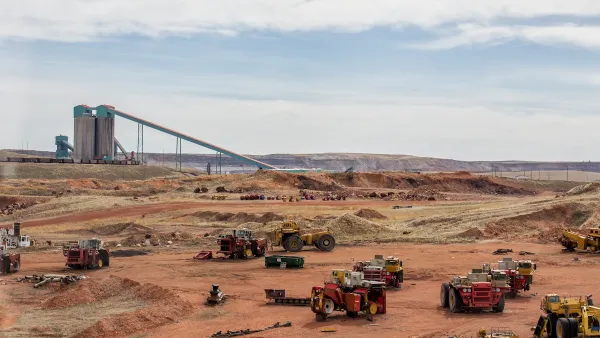
Coal mining in Wyoming will take a major hit as a result of a U.S. Department of Interior plan to cease future leasing of coal mines in the nation's most productive coal mining basin. The decision casts a spotlight on the presidential election.
Supreme Court Guts the U.S. EPA’s Ability to Limit Carbon Emissions
The consequences of this ruling have long been foretold. With the U.S. Environmental Protection Agency now officially barred from the fight against climate change, Congress will have to act to reduce carbon emissions.

Planetizen Federal Action Tracker
A weekly monitor of how Trump’s orders and actions are impacting planners and planning in America.

The state-sanctioned urbicide of Austin
People don’t kill cities. Freeways do.

US to reduce Colorado River water deliveries to Mexico
A new Colorado Treaty amendment reduces Mexico’s Colorado River water allocation by 250,000 acre feet.

5 New England states march closer to 800 megawatt wind energy project
Securing federal approval for the project may be complicated under the Trump administration, which has historically been hostile towards domestic wind power.

Baltimore to break ground on $50 million Transit Priority Project
The project will bring faster bus trips, safer streets and better bike connections to Baltimore.

Airbnb launches $250 million 'last-dollar financing' housing accelerator, makes first investment in Austin
The company will put $6.4 million towards affordable housing development in Texas’ capital.

FREE Course: Walkable City 1: Why Walkability?
After describing his path towards focusing on walkability as the essence of good planning, Jeff Speck marches through his five principal reasons for making more walkable places.
Reinventing Malls: Planning Alchemy—Turning Gray Fields Into Gold
The course focuses on the opportunities and imperatives that shape reinvention of mall sites.

Eagle County Government
Harvard University Graduate School of Design
Nashville Planning Department
The Architects Foundation
University of Cincinnati Online
The Pocatello Development Authority
The Urban Renewal Agency of the City of Pocatello
Journal of the American Planning Association