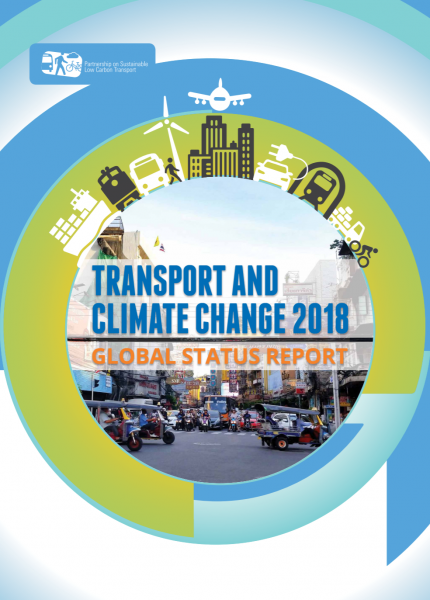
The Sustainable Low Carbon Transportation ( SLoCaT) Partnership recently released the "Transport and Climate Change Global Status Report," a resource to help raise ambition on climate sustainable transportation policy actions.


The Sustainable Low Carbon Transportation ( SLoCaT) Partnership recently released the inaugural edition of the "Transport and Climate Change Global Status Report (TCC-GSR)." The report is a resource for policy-makers. It supports countries, cities, states and provinces, and the private sector in their efforts to raise ambition on climate mitigation and adaptation in sustainable transport. Over 100 individuals from 40 transport-related organizations helped develop the report.
The report's objectives include:
- Bringing together a broad set of information streams on transport and climate change in a regular and actionable report;
- Describing transport sector demand and emission trends, and showing the potential of the sector to contribute to the Paris Agreement 1.5 degree Celsius target; and
- Illustrating transport and climate change policy targets and measures, and how these are influencing market trends over time.
The transport sector contributes roughly one quarter of energy-related GHG emissions and is the fastest growing emissions sector. Against this backdrop, the Global Overview section in Part I of the report compares current trends in transport and climate change across three dimensions -- passenger and freight transport, international aviation and shipping, and global regions -- with respect to transport demand, emissions, and policy measures. Part II of the report describes recent trends in transport demand and transport emissions and illustrates potential Paris Agreement-compliant mitigation pathways.
- Key Findings on Transport Demand: Since 2000, global passenger transport activity has increased 74%, with most of this increase concentrated in non-OECD countries. Between 2000 and 2015, modal share in most countries shifted towards private automobiles and air travel, and away from public transport, while surface freight activity increased by 177%. Urban freight constitutes about 12% of road freight demand (in tonne-km), but generates about 50% of road freight vehicle km.
- Key Findings on Transport Infrastructure: Since 2000, global roadway length increased by about 40%. While conventional railway infrastructure stagnated at 2000 levels, high-speed railway infrastructure increased by nearly 12 times from 1990 levels. Since 2000, there has been significant expansion of BRT (835%), light rail (88%), and metro system (67%) infrastructure, though BRT construction has significantly slowed in recent years.
- Key Findings on Transport Emissions and Mitigation Potential: Transport was the largest growing emission sector between 2000 and 2016 in 40 countries, among which are 29 non-OECD countries across global regions. Non-OECD countries will be responsible for nearly all increases in transport emissions, with their share increasing from 40% in 2015, to a projected 56%-72% in 2050. Cumulative transport mitigation potential in absolute terms is about 60% greater in non-OECD countries than in OECD countries.
These trends in increased demand have contributed to a rise in transport sector CO2 emissions, which grew from 5.8 gigatonnes in 2000 to 7.5 gigatonnes in 2016, an increase of 29%. It is estimated that global transport emissions will need to be reduced to 2 to 3 Gt CO2 by 2050 to meet Paris Agreement mitigation targets. Despite this critical threshold, transport policy targets and measures expressed in nationally determined contributions (NDCs) fall short of what is needed to decarbonize the sector.
“With the urgency highlighted by the IPCC Special Report on Global Warming of 1.5 C, the launch of the TCC-GSR could not be more timely. It shows with concrete case studies from across the globe that low-carbon transport is a central strategy in climate action at global, regional, national, and sub-national levels. At the same time, the TCC-GSR demonstrates that, while possible, the net decarbonization of the transport sector by 2050 will require an immediate and concerted turnaround of global policy and funding. - Maruxa Cardama, Secretary General, SLoCaT Partnership
Part III of the report describes frameworks for transport and climate change planning through the UNFCCC mitigation and adaptation planning processes. It also describes eight major transport policy areas, as illustrated by 180 policy examples from 70 countries across global regions, including extensive case studies from the Global South, within the ‘Avoid-Shift-Improve’ strategy framework:
- Avoid and reduce the need for motorized travel through mobility planning and transport demand management, complemented by new mobility services, which help to reduce vehicle ownership.
- Shift to more environmentally friendly modes of transport by increasing funding for and upgrading the capabilities of urban public transport, railways, and walking/cycling.
- Improve the energy efficiency of transport modes, by enhancing fuel economy of vehicles, increasing access to electric mobility, and promoting investment in renewable energy.
"To decarbonise the transport sector we need renewables. Both the TCC-GSR and REN21’s Renewables GSR track the advancement in the transport and renewable energy sectors to inform policy processes and support integrated approaches. We are very pleased that the TCC-GSR stresses the importance of renewable fuels as no other transport report has done and gives a comprehensive picture of how renewables can contribute to decarbonising the transport sector.” - Rana Adib. Executive Secretary, Renewable Energy Policy Network for the 21st Century (REN21) and Special Advisor to the TCC-GSR
Future editions of the report are envisioned to have increasing emphasis on quantifying the results of policy targets and measures relative to the baselines established in the current report, and to assess these trends relative to the transport sector emission gap. To accomplish this, the TCC-GSR will seek to establish in-country networks to help compile more current and comprehensive transport data.
Read the full story: Transport and Climate Change Global Status Report: Tracking Transport Emissions Trends, Raising Transport Policy Ambition

A Carbon-Neutral City?
A region known more for carbon emissions strives to create a carbon-neutral city powered by renewable energy and designed to reduce overall energy demand.
EPA erases limits on planet-warming pollution from power plants
Under Monday’s plan, power plants would still have some limits on how much mercury, arsenic and other contaminants they can emit.
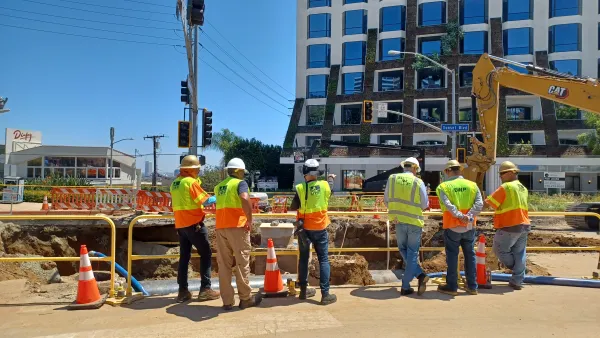
Climate change is battering US water systems
The American Water Works Association estimates that roughly $2 trillion will be needed to update municipal water systems for contemporary conditions.

Planetizen Federal Action Tracker
A weekly monitor of how Trump’s orders and actions are impacting planners and planning in America.

The state-sanctioned urbicide of Austin
People don’t kill cities. Freeways do.

Colorado’s Largest Data Center Could Rise Next to Homes — Without a Public Hearing
The proposed campus would consume 11 times the power of Denver International Airport; as it has across the country, opposition mounts.

Judges permit Denver to divert 77,000 acre feet from the Colorado River for reservoir expansion
Overuse and climate change have caused the Colorado River’s water levels to plummet.

Amtrak, CN end decades-long dispute with eight-year agreement
The new operating agreement establishes an updated framework for the companies to work together, including processes to resolve disputes.
Raised interest rates may kill financially vulnerable construction projects
The chief economist at ConstructConnect warns that if construction project owners are negatively impacted by the raised rates, it could result in delayed payments to contractors.

FREE Course: Walkable City 1: Why Walkability?
After describing his path towards focusing on walkability as the essence of good planning, Jeff Speck marches through his five principal reasons for making more walkable places.
Reinventing Malls: Planning Alchemy—Turning Gray Fields Into Gold
The course focuses on the opportunities and imperatives that shape reinvention of mall sites.

KFH Group Inc.
Greater Baltimore Committee
Eagle County Government
The Architects Foundation
University of Cincinnati Online
The Pocatello Development Authority
The Urban Renewal Agency of the City of Pocatello