With several stipulations, Seattle City Council has signed off on the university's plans for up to 6 million square feet of new construction, including high-rises.


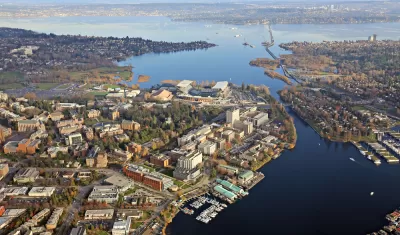
A ten-year vision to accommodate another 7,000 students and staff, the UW's expansion plans call for 6 million square feet of new construction. Seattle City Council has approved the plan this month, Daniel Beekman writes, after preliminary approval in September.
The plan includes an "innovation district" made up of "high rises there where students and researchers can partner with companies, governments and nonprofits to start new projects and businesses." Towers as tall as 17 stories may rise in the vicinity of the medical center.
City Council approval came with a stipulation that "the university must have no more than 12 percent of students and employees commute by driving alone by 2028," strengthening the university original proposal of 15 percent.
Another condition previously required the university to build at least 450 units of affordable housing for low-wage employees. The UW subsequently agreed to do so as long as the construction was treated as voluntary. One councilmember, Kshama Sawant, approved the plan but called 450 units a "paltry number when you consider the actual need."
FULL STORY: Seattle City Council approves plan for UW to build 6 million square feet, add high-rise district

Capital Gains Tax Under Consideration in Seattle
A proposed capital gains tax would invest $37 million per year in solving affordable housing and homelessness crises in Seattle.
The Cost of Solving Homelessness in Seattle: $400 Million
It’s "dramatically higher" than any number under discussion, and not even close to what the city will raise with its new tax on large businesses.

Seattle church complex includes 87 affordable homes
The Columbia City Church of Hope deeded part of its property to an affordable housing developer after limiting in-person congregation during the pandemic.

The state-sanctioned urbicide of Austin
People don’t kill cities. Freeways do.

US to reduce Colorado River water deliveries to Mexico
A new Colorado Treaty amendment reduces Mexico’s Colorado River water allocation by 250,000 acre feet.

New Jersey’s second-largest city bans standalone data centers
Jersey City will continue to allow co-location facilities, such as those meant for research institutions that store their own data.

Amtrak not solely to blame for New Jersey commuter rail's unreliability, report finds
A new study from the Garden State Initiative found that NJ Transit’s budget grew 20% across a 4 year period, but reliability declined significantly over the same period.

EPA erases limits on planet-warming pollution from power plants
Under Monday’s plan, power plants would still have some limits on how much mercury, arsenic and other contaminants they can emit.

Phoenix announces new on-demand transit service, more frequent RAPID buses
Both new services will launch in October, and are part of Phoenix's Project Effective Access Solutions for Easing Congestion.

FREE Course: Walkable City 1: Why Walkability?
After describing his path towards focusing on walkability as the essence of good planning, Jeff Speck marches through his five principal reasons for making more walkable places.
Reinventing Malls: Planning Alchemy—Turning Gray Fields Into Gold
The course focuses on the opportunities and imperatives that shape reinvention of mall sites.

Eagle County Government
Harvard University Graduate School of Design
Nashville Planning Department
The Architects Foundation
University of Cincinnati Online
The Pocatello Development Authority
The Urban Renewal Agency of the City of Pocatello
Journal of the American Planning Association