The bus rapid transit route known as the HealthLine has been in operation in Cleveland for ten years, with a measurably positive impact on the city, measured in development investment.


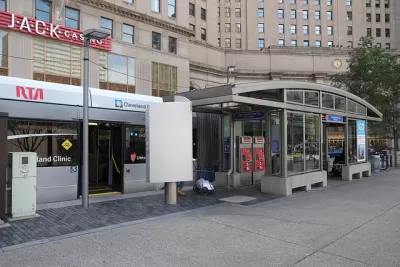
"Ten years ago, while the economy plummeted, a national first called the HealthLine began in October to take riders up and down Euclid Avenue," writes Grant Segall.
"Today, the Regional Transit Authority estimates that the $200 million invested in its HealthLine has spurred about $9.5 billion in development along the resurging Euclid Corridor, a remarkable return of $190 per dollar," explains Segall.
Local officials celebrated the 10th anniversary of the HealthLine's launch yesterday, on November 7, 2018.
"Fast, frequent and 24/7, the HealthLine runs from a revamped Public Square past converted condominiums, a swanky Nine complex, a chandelier-topped Playhouse Square, a Cleveland State Campus transformed from fortress to welcome mat, a renovated mansion newly hosting the Children’s Museum, a new University Hospitals Rainbow clinic, an ever-expanding Cleveland Clinic, a mushrooming University Circle and other spiffed-up sites before reaching Stokes/Windermere," writes Segall.
Planetizen has also noted the positive impact on the city, as well as the national significance of the HealthLine's model, on several occasions over the years. Here's what we found from our archives on those subjects:
FULL STORY: RTA says HealthLine had 10-year payback of $9.5 billion, ‘woke up’ Euclid Corridor

10 Years of Bus Rapid Transit in the United States
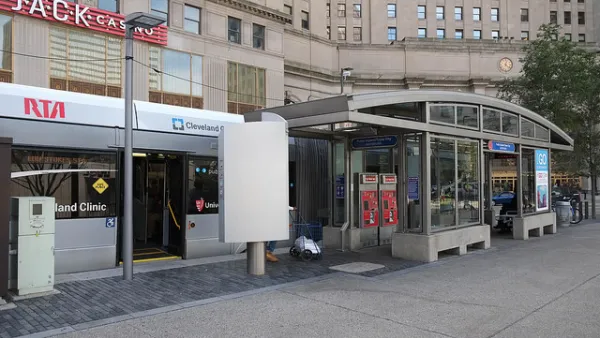
The first examples of bus rapid transit built int he United States, all within the last ten years, are improving speeds and outperforming ridership projections, according to analysis by Streetsblog USA.
HealthLine Pumps Life into Cleveland
Cleveland's bus rapid transit system, called the HealthLine, only opened in 2008, but it has already shown signs of "stimulating economic growth significantly" along Euclid Avenue.
BRT Boom in U.S.
A new study says that Los Angeles, Cleveland, Las Vegas, Eugene and Pittsburgh are leading the surge with the best bus rapid transit (BRT) systems in the nation.

Planetizen Federal Action Tracker
A weekly monitor of how Trump’s orders and actions are impacting planners and planning in America.

The state-sanctioned urbicide of Austin
People don’t kill cities. Freeways do.

US to reduce Colorado River water deliveries to Mexico
A new Colorado Treaty amendment reduces Mexico’s Colorado River water allocation by 250,000 acre feet.

5 New England states march closer to 800 megawatt wind energy project
Securing federal approval for the project may be complicated under the Trump administration, which has historically been hostile towards domestic wind power.

Baltimore to break ground on $50 million Transit Priority Project
The project will bring faster bus trips, safer streets and better bike connections to Baltimore.

Airbnb launches $250 million 'last-dollar financing' housing accelerator, makes first investment in Austin
The company will put $6.4 million towards affordable housing development in Texas’ capital.

FREE Course: Walkable City 1: Why Walkability?
After describing his path towards focusing on walkability as the essence of good planning, Jeff Speck marches through his five principal reasons for making more walkable places.
Reinventing Malls: Planning Alchemy—Turning Gray Fields Into Gold
The course focuses on the opportunities and imperatives that shape reinvention of mall sites.

Eagle County Government
Harvard University Graduate School of Design
Nashville Planning Department
The Architects Foundation
University of Cincinnati Online
The Pocatello Development Authority
The Urban Renewal Agency of the City of Pocatello
Journal of the American Planning Association