The U.S. Army Corps of Engineers has proposed a suite of coastal infrastructure projects—i.e., floodgates and seawalls—to shore up the coast of Texas against Hurricane- and sea level rise-aided water.


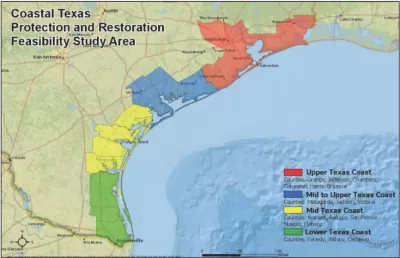
"Following years of research, studies and public debate, the U.S. Army Corps of Engineers — in partnership with the state’s General Land Office — has recommended a multi-billion-dollar project that would protect the Houston area and its massive industrial complex from hurricane storm surge," reports Kiah Collier.
The Army Corps selected a final plan from four alternative proposals [pdf], with varying configurations of levees, seawalls, and locks, according to Collier, settling on a plan originally called the Ike Dike, but now called the "coastal spine."
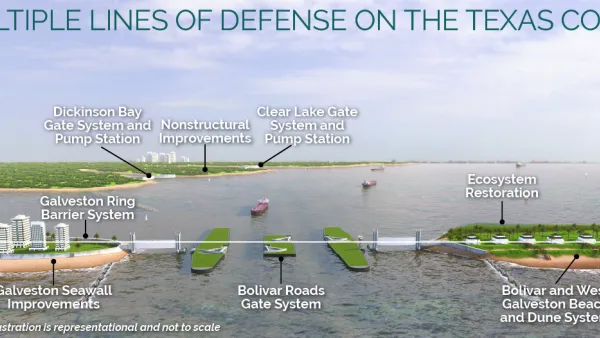
The sweeping plan calls for the construction of a levee along Galveston Island and the peninsula to its north, Bolivar, as well as the installation of a gate between the two isles to keep storm surge from pouring between them into Galveston Bay and the Port of Houston. It also includes improvements to Galveston's existing seawall and a “ring levee” around the heart of the city. Such a structure would protect the backside of the most densely populated area from surge and flood waters retreating to the Gulf of Mexico following a storm.
The Army Corps "also identified extensive 'non-structural improvements' — such as beach renourishment and dune restoration — for much of the Texas coast," adds Collier.
FULL STORY: Army Corps, Texas officials propose sweeping hurricane protection plan

Revised Plans for Massive 'Ike Dike' Plan Revealed
A $26.2 billion proposal to protect the coastal area around Galveston has evolved since its first iteration in 2018.
$31 Billion ‘Ike Dike’ Hurricane Protection Project Moving Through Congress
Congress authorized the $31 billion ‘Ike Dike’ sea-level rise adaptation project, along with a laundry list of other water infrastructure projects.
Looking for a Beach House? Check Your Risk First.
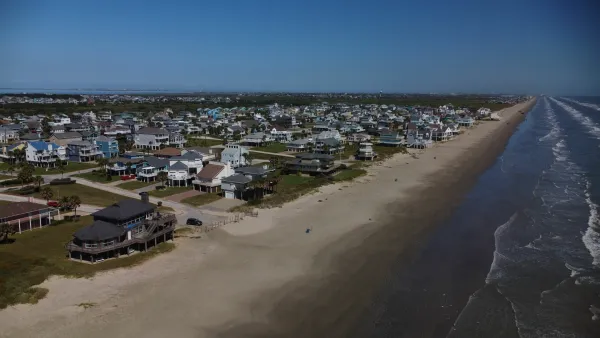
A new report from the insurance industry names the historic town of Galveston, Texas as the riskiest place to buy a beach house in the United States.

Planetizen Federal Action Tracker
A weekly monitor of how Trump’s orders and actions are impacting planners and planning in America.

The state-sanctioned urbicide of Austin
People don’t kill cities. Freeways do.

US to reduce Colorado River water deliveries to Mexico
A new Colorado Treaty amendment reduces Mexico’s Colorado River water allocation by 250,000 acre feet.

5 New England states march closer to 800 megawatt wind energy project
Securing federal approval for the project may be complicated under the Trump administration, which has historically been hostile towards domestic wind power.

Baltimore to break ground on $50 million Transit Priority Project
The project will bring faster bus trips, safer streets and better bike connections to Baltimore.

Airbnb launches $250 million 'last-dollar financing' housing accelerator, makes first investment in Austin
The company will put $6.4 million towards affordable housing development in Texas’ capital.

FREE Course: Walkable City 1: Why Walkability?
After describing his path towards focusing on walkability as the essence of good planning, Jeff Speck marches through his five principal reasons for making more walkable places.
Reinventing Malls: Planning Alchemy—Turning Gray Fields Into Gold
The course focuses on the opportunities and imperatives that shape reinvention of mall sites.

Eagle County Government
Harvard University Graduate School of Design
Nashville Planning Department
The Architects Foundation
University of Cincinnati Online
The Pocatello Development Authority
The Urban Renewal Agency of the City of Pocatello
Journal of the American Planning Association