A local issue with regional consequences: Measure JJ would approve a scaled back version of a development proposal at the Baylands site in the San Francisco suburb of Brisbane.


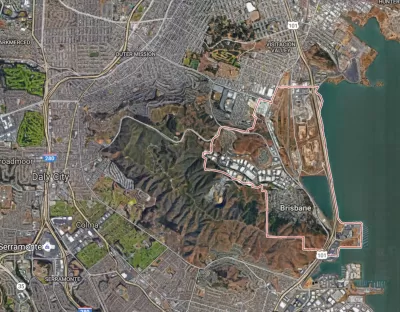
J.K. Dineen reports from Brisbane, California, located on the Peninsula south of San Francisco, where Measure JJ on the ballot this November will decide the fate of the 684-acre former rail yard and landfill known as the Baylands.
Dineen explains the significance of the vote on Measure JJ:
But while only Brisbane’s 2,686 registered voters will weigh in on Measure JJ, it’s not just Brisbane residents who are interested. Across the region the future of one of the Bay Area’s biggest buildable sites is seen as a litmus test of whether Bay Area towns have the political will to tackle the ongoing housing crisis, even if that means disruption in a town many residents like the way it is.
The way it is: the Baylands is zoned for commercial use and in need of environmental remediation. The property owners have proposed about 4,000 residential units on the site, which happens to be located near both a Caltrain station and the T-Third Muni line. Measure JJ counters with a scaled-back proposal, and local leaders consider the vote a chance to retain local control in the face of mounting pressure from the state to build infill and transit oriented development to higher thresholds of density.
Dineen's feature-length article covers Measure JJ, the activists on either side of the issue Brisbane, the regional housing crisis, and the different outcomes still in play for the Baylands site.
Previous Planetizen coverage of the Baylands proposal and resulting controversy:
FULL STORY: Brisbane voters making tough choices on housing with Baylands project


Transit Oriented Development Shifts Into High Gear Near BART Stations in the Bay Area
Transportation and land use are being considered together at a new scale in the Bay Area, as transit oriented development pops up next to BART stations all over the region.
Study: Cuyahoga County Suburbs Ready for TOD
The growth of transit-oriented development in the Cleveland region is being hindered by zoning codes that limit housing density and excessive parking requirements that drive up construction costs, new research suggests.

The Imagined Bay Area of 2070: Affordable, Equitable, Prosperous
An opinion published recently by the San Francisco Chronicle offers a provocative thought exercise: How did the Bay Area of 2070 achieve affordability, equity, sustainability and adaptation in the face of climate change, and new levels of prosperity?

The state-sanctioned urbicide of Austin
People don’t kill cities. Freeways do.

US to reduce Colorado River water deliveries to Mexico
A new Colorado Treaty amendment reduces Mexico’s Colorado River water allocation by 250,000 acre feet.

New Jersey’s second-largest city bans standalone data centers
Jersey City will continue to allow co-location facilities, such as those meant for research institutions that store their own data.

Amtrak not solely to blame for New Jersey commuter rail's unreliability, report finds
A new study from the Garden State Initiative found that NJ Transit’s budget grew 20% across a 4 year period, but reliability declined significantly over the same period.

EPA erases limits on planet-warming pollution from power plants
Under Monday’s plan, power plants would still have some limits on how much mercury, arsenic and other contaminants they can emit.

Phoenix announces new on-demand transit service, more frequent RAPID buses
Both new services will launch in October, and are part of Phoenix's Project Effective Access Solutions for Easing Congestion.

FREE Course: Walkable City 1: Why Walkability?
After describing his path towards focusing on walkability as the essence of good planning, Jeff Speck marches through his five principal reasons for making more walkable places.
Reinventing Malls: Planning Alchemy—Turning Gray Fields Into Gold
The course focuses on the opportunities and imperatives that shape reinvention of mall sites.

Eagle County Government
Harvard University Graduate School of Design
Nashville Planning Department
The Architects Foundation
University of Cincinnati Online
The Pocatello Development Authority
The Urban Renewal Agency of the City of Pocatello
Journal of the American Planning Association