Despite the disappointment of losing a stadium deal to the financial concerns of St. Louis voters, Major League Soccer is willing to give the city another look.


"St. Louis hasn’t given up on major league soccer," report Brian Feldt and Jack Suntrup.
"An official in Gov. Mike Parson’s office told the Post-Dispatch that officials with the state Department of Economic Development met with Major League Soccer representatives as recently as Tuesday, and that the Parson administration was interested in working on a stadium proposal," according to the article.
Details about the development its under discussion are not available, however, so the Maryland Heights parcel, a former potential development site for an MLS franchise that is now a massive parcel of interest for redevelopment investors, could still be on the table, or not.
Feldt and Suntrup speculate that the process could be harbinger of "another drawn-out process in which MLS officials seek to engage with municipal leaders about potentially helping to fund a soccer stadium to pave the way for a team." Previous episodes of that narrative haven't gone well for professional sports teams in St. Louis, even with MLS.
In a recent statement, Major League Soccer Commissioner Don Garber said St. Louis is in the running as a potential expansion city, along with Detroit, San Diego, Charlotte, Las Vegas, and Phoenix.
Read the full story: Soccer stadium talks back on in St. Louis
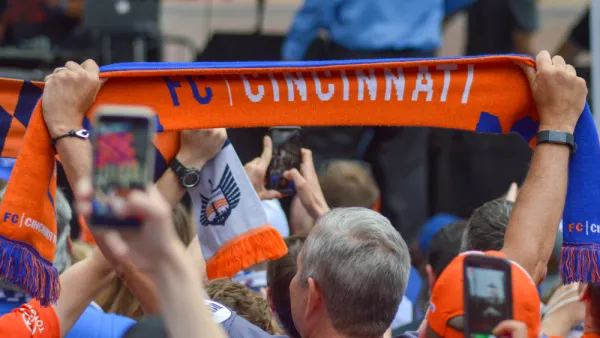
Plans Released for New $200 Million MLS Stadium in Cincinnati
The Major League Soccer Team FC Cincinnati is planning on building a stadium, along with attached mixed-use development, in the West End neighborhood of its hometown.
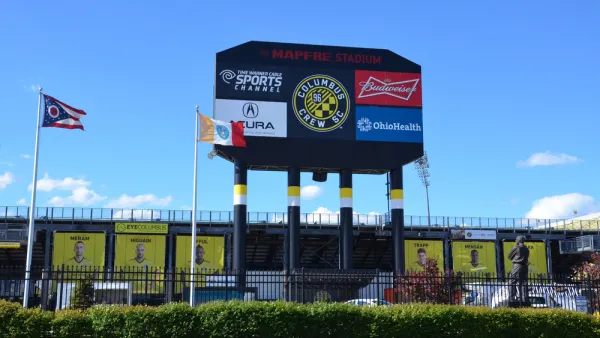
Austin Approves New Stadium to Lure Columbus' Soccer Team
The Austin City Council approved plans for a new, privately financed soccer stadium to become the future home of the team currently known as the Columbus Crew.
Soccer Brings Development Hopes, and Displacement Fears, to Cincinnati
A proposal for a Major League Soccer (MLS) stadium in Cincinnati's West End is raising displacement concerns among residents.

Planetizen Federal Action Tracker
A weekly monitor of how Trump’s orders and actions are impacting planners and planning in America.

California plans to bury El Niño’s downpour
If the state plays its cards right, it may be able to store a billion acre-feet of El Niño’s water in aquifers.

Desperate measures: Advocates weigh draining Lake Powell to fill Colorado River
Draining the reservoir could reduce evaporation losses by a couple hundred thousand acre-feet.

Mamdani’s pied-à-terre tax survives legal challenge
A panel of judges found that the plaintiffs failed to demonstrate injury as a result of New York City's implementation of the tax.

Eastern Nebraska is running out of electricity
Data centers and electrification are straining eastern Nebraska’s grid, throttling economic development.

Seattle passes record-breaking transit services expansion
Proposition 1 will double the city’s transit tax to add 95,000 more bus trips and preserve 180,000 bus trips annually.

FREE Course: Walkable City 1: Why Walkability?
After describing his path towards focusing on walkability as the essence of good planning, Jeff Speck marches through his five principal reasons for making more walkable places.
Reinventing Malls: Planning Alchemy—Turning Gray Fields Into Gold
The course focuses on the opportunities and imperatives that shape reinvention of mall sites.

City of Rosemead
Rutgers University, Edward J. Bloustein School of Planning and Public Policy
One Hundred Miles
Hunter College, City University of New York (CUNY)
The Architects Foundation
University of Cincinnati Online
City of Cambridge
Montrose County
The Pocatello Development Authority