Are housing and housing finance two separate problems? California Assemblymember David Chiu and others in housing discuss how available finance tools could be employed to expand the capital pool for affordable housing projects.


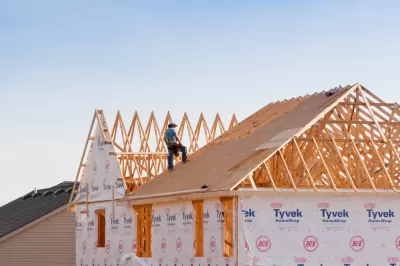
California cities, especially coastal cities, continue to struggle to meet market calls for more homeless, low and moderately priced housing to meet unmet demand. Lack of adequate financial incentives that support various types of development demanded throughout the state contribute to the supply crisis. In The Planning Report, state leaders discuss what they can do to incentivize more housing development at the local level, and how available finance tools could be employed to expand the capital pool for affordable housing projects.
California Assemblymember David Chiu, the Chair of the Housing and Community Development Committee and author of numerous housing and transit-oriented development bills in the California legislature over the past three sessions, spoke about the need of creating more funding to build the affordable housing needed in California. He stated, "we need to think about traditional answers, like expanding the affordable housing tax credit and bringing back some version of redevelopment, but we also need to think innovatively. I’ve proposed that we think about the billions of dollars we are currently spending on the mortgage interest deduction—and whether that’s the best use of money, or whether we could use that money to build affordable housing. I’ve also proposed exempting property taxes for developers that build missing middle housing."
Asm. Chiu also noted the decreased support of the federal government in financing and maintaining affordable projects. Chiu remarked that "HUD is cutting billions of dollars of resources to states like California," and that the changes to tax policy are "gutting [California's] ability to use affordable housing tax credit tools. Last year, the legislature had a major breakthrough with a package of bills that I see as an initial down payment on solving this problem. But down payments solve 20 percent of your problem."
When asked about how lawmakers in California plan to address the issue in 2019 and beyond, Asm. Chiu supported "a significant expansion of the Low-Income Housing Tax Credit" and "bringing back Redevelopment 2.0." Chiu remarked that "tax-increment financing worked, particularly when it came to housing and infrastructure."
The piece also features remarks from Beth Ruyak of Capital Public Radio, Vice Mayor Steve Hansen from the City of Sacramento, YIMBY Action Director Laura Foote Clark, Genetech's Carla Boragno, Related California's Bill Witte.
Read more in The Planning Report.
FULL STORY: Milken California Policy Summit Asks: Will Innovative Financing Solve California's Housing Shortage?


What Do Affordable Housing Developers Think of California's Potential Rent Control Initiative?
A California November 2018 ballot initiative seeking to repeal the Costa-Hawkins Rental Housing Act could have unintended consequences, according to Related California's Bill Witte.

Supply, Demand, and Affordable Housing
Bill Witte, president of Related California, one of the most active developers of residential and commercial properties on the West Coast, talks about real estate, affordable housing, and a squeezed middle class with The Planning Report.

What Has Measure ULA Achieved?
Los Angeles has imposed an additional tax on luxury home sales to generate millions for housing efforts in the city. Shelterforce checks in on where the money has gone, and what’s to come.

The state-sanctioned urbicide of Austin
People don’t kill cities. Freeways do.

US to reduce Colorado River water deliveries to Mexico
A new Colorado Treaty amendment reduces Mexico’s Colorado River water allocation by 250,000 acre feet.

New Jersey’s second-largest city bans standalone data centers
Jersey City will continue to allow co-location facilities, such as those meant for research institutions that store their own data.

Amtrak not solely to blame for New Jersey commuter rail's unreliability, report finds
A new study from the Garden State Initiative found that NJ Transit’s budget grew 20% across a 4 year period, but reliability declined significantly over the same period.

EPA erases limits on planet-warming pollution from power plants
Under Monday’s plan, power plants would still have some limits on how much mercury, arsenic and other contaminants they can emit.

Phoenix announces new on-demand transit service, more frequent RAPID buses
Both new services will launch in October, and are part of Phoenix's Project Effective Access Solutions for Easing Congestion.

FREE Course: Walkable City 1: Why Walkability?
After describing his path towards focusing on walkability as the essence of good planning, Jeff Speck marches through his five principal reasons for making more walkable places.
Reinventing Malls: Planning Alchemy—Turning Gray Fields Into Gold
The course focuses on the opportunities and imperatives that shape reinvention of mall sites.

Eagle County Government
Harvard University Graduate School of Design
Nashville Planning Department
The Architects Foundation
University of Cincinnati Online
The Pocatello Development Authority
The Urban Renewal Agency of the City of Pocatello
Journal of the American Planning Association