The proposed property tax would double the county's stormwater capture capacity.


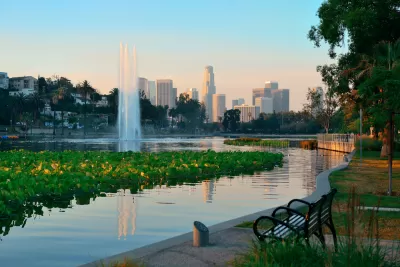
Sharon McNary reports on the details of a ballot initiative in Los Angeles County that will drastically increase the stormwater capture capacity in the region.
"Two-thirds of voters in the Los Angeles County Flood Control District (more on that below) need to say yes," according to McNary. "If that happens, then property owners would be charged a new tax of 2.5 cents each year for every square foot of land that sheds water."
The tax will fund stormwater capture and treatment projects in the 2,700-square-mile flood control district. "Los Angeles County already captures about one-fifth of the rain that falls in the L.A. Basin watershed. Money raised by the new tax — an estimated $300 million per year — would ultimately double the amount captured," adds McNary. The article includes a lot more detail about the scope of infrastructure proposed and the politics of stormwater in Los Angeles County.
Read the full story: Everything LA County Voters Need To Know About The Stormwater Tax Now On Their November Ballot

L.A. Unveils Plans for Historic Water Infrastructure Tax
Katy Young Yaroslavsky discusses the the Measure W Implementation Ordinance and the committee appointees tasked with determining how this new funding will flow into community water projects.

Los Angeles Wants its River Back From the Feds
Regional officials don't think the federal government is doing enough to warrant continued ownership of the Los Angeles River flood control channels that cut a 40-mile path through the city and county.
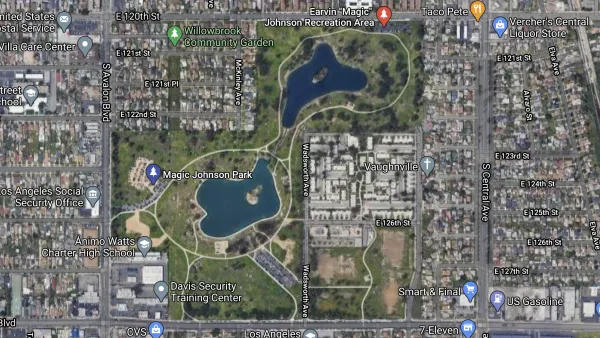
South Los Angeles Park Offers Hidden Benefits
Not only does the redevelopment of a large section of Earvin Magic Johnson Park in Willowbrook offer much needed green space and new amenities, it also helps to conserve water and improve water quality.

Planetizen Federal Action Tracker
A weekly monitor of how Trump’s orders and actions are impacting planners and planning in America.

California plans to bury El Niño’s downpour
If the state plays its cards right, it may be able to store a billion acre-feet of El Niño’s water in aquifers.

Chicago breaks ground on $3 billion megadevelopment
The new neighborhood, titled Foundry Park, will one day host 3,700 residences.

Satanic Place Names
From streams and lakes to valleys and canyons, I mapped more than 1,000 places named after the Devil.

California High-Speed Rail Authority CEO resigns after $600,000 scandal
Under Ian Choudri, the authority used taxpayer dollars to fund first class flights and trips to nightclubs.

Want to study the Missouri River? Soon, you may need unanimous approval from 10 states
Legislation would require 10 governors’ permission to study or build projects moving water outside the basin.

FREE Course: Walkable City 1: Why Walkability?
After describing his path towards focusing on walkability as the essence of good planning, Jeff Speck marches through his five principal reasons for making more walkable places.
Reinventing Malls: Planning Alchemy—Turning Gray Fields Into Gold
The course focuses on the opportunities and imperatives that shape reinvention of mall sites.

City of Rosemead
Rutgers University, Edward J. Bloustein School of Planning and Public Policy
One Hundred Miles
Hunter College, City University of New York (CUNY)
The Architects Foundation
University of Cincinnati Online
City of Cambridge
Montrose County
The Pocatello Development Authority