A CommonWealth Magazine editorial argues that gondolas over Summer Street in Boston's Seaport district are less practical than busses, which could avoid traffic with a dedicated lanes.


The Boston Seaport neighborhood should get more transit, but rather than a new gondola service, some argue the area would be better served by buses. "Instead of running cables over Summer Street, we should be running buses on it, in their own lane. Running the Silver Line underground and bus rapid transit above would essentially double the number of transit seats serving the Seaport at a time when traffic is threatening to choke the neighborhood before it gets off the ground," Ari Ofsevit and Eitan Kensky argue in CommonWealth Magazine. Besides a cost savings over a gondola, extending the Silver Line could leverage existing transit resources so trips that would previously have required a transfer could now become a straight shot.
"If we’re willing to make a bigger investment, we should convert the existing underground Silver Line into an extension of the Green Line, by extending the Green Line from a point near Boylston Station to South Station," Ofsevit and Kensky write. If Boston were to "Turn the Silver Line Green," as the authors suggest, the city would need to dig an additional tunnel to extend the track but, if the city were willing to make that investment it would add capacity to the crowded Silver Line and bring more people to Seaport.
FULL STORY: Forget gondolas, turn Silver Line Green

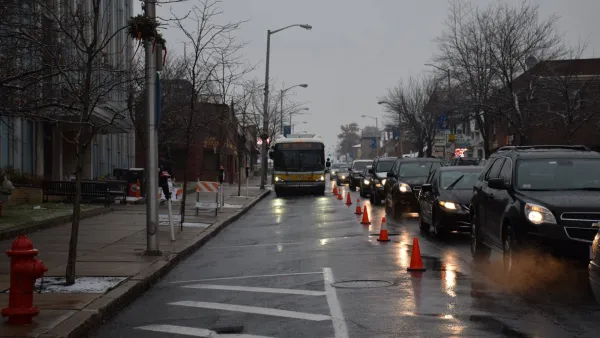
How to Improve Bus Service and Performance on Busy Corridors
A new report collects the lessons and best practices of several years of bus priority projects in the Boston region.
Transit Plans Change as the Pandemic Lingers
The Massachusetts Bay Transportation Authority (MBTA) this week proposed cuts to public transit service. In a decision that will likely repeat as more transit agencies undertake similar processes, the MBTA decided to prioritize buses over trains.
'Rapid Response Bus Lanes' Program Provides Equitable Mobility Relief During the Pandemic
A new Massachusetts Bay Transportation Authority program has quickly deployed bus infrastructure around the Boston area, focusing on neighborhoods where people are relying on the bus during the pandemic.

The state-sanctioned urbicide of Austin
People don’t kill cities. Freeways do.

US to reduce Colorado River water deliveries to Mexico
A new Colorado Treaty amendment reduces Mexico’s Colorado River water allocation by 250,000 acre feet.

New Jersey’s second-largest city bans standalone data centers
Jersey City will continue to allow co-location facilities, such as those meant for research institutions that store their own data.

Amtrak not solely to blame for New Jersey commuter rail's unreliability, report finds
A new study from the Garden State Initiative found that NJ Transit’s budget grew 20% across a 4 year period, but reliability declined significantly over the same period.

EPA erases limits on planet-warming pollution from power plants
Under Monday’s plan, power plants would still have some limits on how much mercury, arsenic and other contaminants they can emit.

Phoenix announces new on-demand transit service, more frequent RAPID buses
Both new services will launch in October, and are part of Phoenix's Project Effective Access Solutions for Easing Congestion.

FREE Course: Walkable City 1: Why Walkability?
After describing his path towards focusing on walkability as the essence of good planning, Jeff Speck marches through his five principal reasons for making more walkable places.
Reinventing Malls: Planning Alchemy—Turning Gray Fields Into Gold
The course focuses on the opportunities and imperatives that shape reinvention of mall sites.


Eagle County Government
Harvard University Graduate School of Design
Nashville Planning Department
The Architects Foundation
University of Cincinnati Online
The Pocatello Development Authority
The Urban Renewal Agency of the City of Pocatello
Journal of the American Planning Association