The federal government appears to be reneging on yet another promise to Native American tribes.


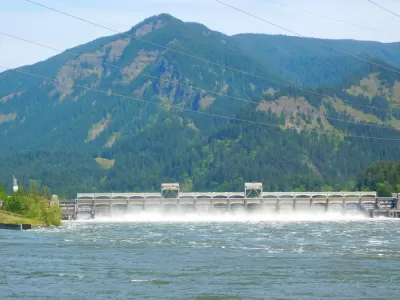
The Office of Management and Budget has abruptly rejected the U.S. Army Corps' request for $1.6 million to plan and develop a new town for several Native tribes at the Washington-Oregon border.
The new development was planned to replace a number of towns that were destroyed by the construction of a series of dams on the Columbia River beginning in the 1930s. "Since then, many Native Americans have lived at least six months out of the year on 30 fishing sites not made for full-time human habitation," often with limited access to restrooms, Molly Harbarger explains in The Oregonian. The government recognized its obligation to replace the lost homes in 2016.
To do so, the U.S. Army Cops had requested $1.6 million out of a fund normally used to maintain the lower river basin, which was experiencing a surplus. All signs pointed to the transfer being approved, and the planning process for the new town had begun.
Now, the White House's surprise decision "has again left hundreds of Native Americans in unsafe, unsanitary makeshift housing for the foreseeable future," Harbarger notes.
FULL STORY: Planning for Columbia River tribal village stalls after funding denied by White House

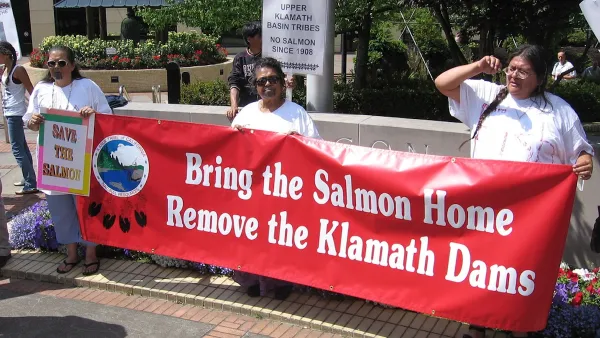
Last Dam in Klamath River Removal Project Comes Down
Salmon can now move freely along the river and its tributaries for the first time in over a century.
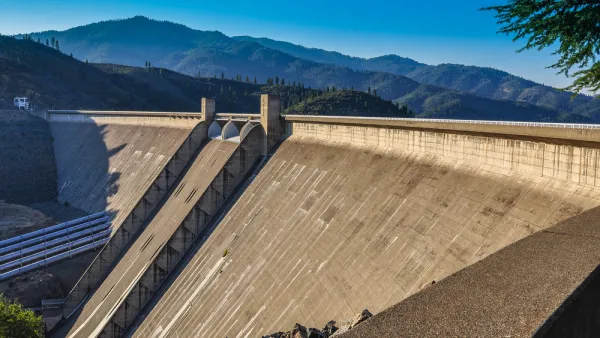
Why Are the Feds Suddenly in Favor of Raising the Shasta Dam?
Despite state opposition and potential violations of California law, the Trump Administration has revived a project that was deemed impracticable only a few years ago.
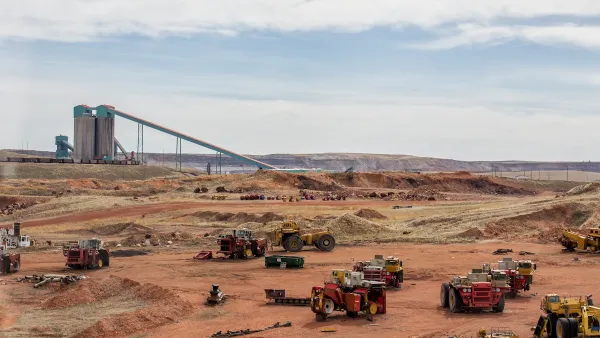
A Win for ‘Keep it in the Ground’
Coal mining in Wyoming will take a major hit as a result of a U.S. Department of Interior plan to cease future leasing of coal mines in the nation's most productive coal mining basin. The decision casts a spotlight on the presidential election.

Planetizen Federal Action Tracker
A weekly monitor of how Trump’s orders and actions are impacting planners and planning in America.

The state-sanctioned urbicide of Austin
People don’t kill cities. Freeways do.

US to reduce Colorado River water deliveries to Mexico
A new Colorado Treaty amendment reduces Mexico’s Colorado River water allocation by 250,000 acre feet.

5 New England states march closer to 800 megawatt wind energy project
Securing federal approval for the project may be complicated under the Trump administration, which has historically been hostile towards domestic wind power.

Baltimore to break ground on $50 million Transit Priority Project
The project will bring faster bus trips, safer streets and better bike connections to Baltimore.

Airbnb launches $250 million 'last-dollar financing' housing accelerator, makes first investment in Austin
The company will put $6.4 million towards affordable housing development in Texas’ capital.

FREE Course: Walkable City 1: Why Walkability?
After describing his path towards focusing on walkability as the essence of good planning, Jeff Speck marches through his five principal reasons for making more walkable places.
Reinventing Malls: Planning Alchemy—Turning Gray Fields Into Gold
The course focuses on the opportunities and imperatives that shape reinvention of mall sites.

Eagle County Government
Harvard University Graduate School of Design
Nashville Planning Department
The Architects Foundation
University of Cincinnati Online
The Pocatello Development Authority
The Urban Renewal Agency of the City of Pocatello
Journal of the American Planning Association