Six pilot cities are selected for the launch of a new federal, interagency initiative know as 'Strong Cities, Strong Communities': Fresno, New Orleans, Detroit, Cleveland, Memphis and Chester, PA.


'Strong Cities, Strong Communities', explained by Melody Barnes, assistant to the president for domestic policy and the director of the White House Domestic Policy Council, is primarily intended to increase economic growth in the six selected cities. “Strong Cities, Strong Communities is a new interagency pilot initiative that aims to strengthen neighborhoods, towns, cities and regions around the country by strengthening the capacity of local governments to develop and execute their economic vision and strategies."
Barnes explains that the "federal-local collaboration allows the federal government to support efforts from the ground up in four key ways", including the formation of a new "fellowship program (managed by the Dept. of Housing and Urban Development) that will place mid-career professionals in city agencies in the same six cities to work closely with the Community Solutions Teams..."
Thanks to Sarah Sharpe
Read the full story: Announcing Strong Cities, Strong Communities

Learning loss and urban schools, part 2
Did test scores in progressive cities drop more post-COVID than test scores in moderate ones?
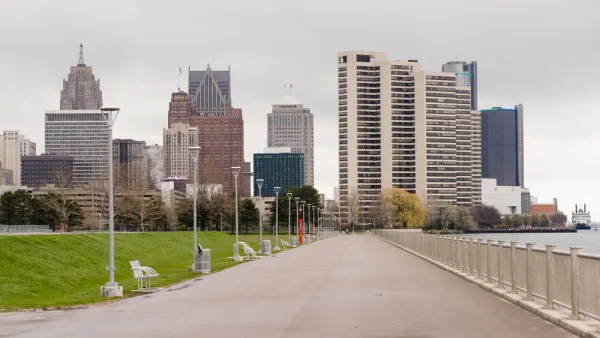
Shaping a 15-Minute City Vision for Detroit and Cleveland Using Data-Assisted Modeling
How master plans in the two cities hope to transform their historic, and historically underutilized, waterfronts.
Choice Neighborhood Planning Grants Announced for 5 U.S. Cities
A federal grant program designed to support holistic and socially-focused planning projects at the neighborhood level has announced the winners of its most recent round of competitive grant funding.

Planetizen Federal Action Tracker
A weekly monitor of how Trump’s orders and actions are impacting planners and planning in America.

California plans to bury El Niño’s downpour
If the state plays its cards right, it may be able to store a billion acre-feet of El Niño’s water in aquifers.

Desperate measures: Advocates weigh draining Lake Powell to fill Colorado River
Draining the reservoir could reduce evaporation losses by a couple hundred thousand acre-feet.

Non-stop party: Chicago voters weigh permanent festival grounds
A stable place for bleachers, stages and drainage may streamline the setup and teardown of large events.

Metra may invest $9.1 billion in regional rail
The agency released a draft of a study examining potential ways to offer more frequent train service.

California city breaks ground on transit connector
The project includes three mobility hubs and a pedestrian bridge.

FREE Course: Walkable City 1: Why Walkability?
After describing his path towards focusing on walkability as the essence of good planning, Jeff Speck marches through his five principal reasons for making more walkable places.
Reinventing Malls: Planning Alchemy—Turning Gray Fields Into Gold
The course focuses on the opportunities and imperatives that shape reinvention of mall sites.

City of Rosemead
Rutgers University, Edward J. Bloustein School of Planning and Public Policy
One Hundred Miles
Hunter College, City University of New York (CUNY)
The Architects Foundation
University of Cincinnati Online
City of Cambridge
Montrose County
The Pocatello Development Authority