A federal grant program designed to support holistic and socially-focused planning projects at the neighborhood level has announced the winners of its most recent round of competitive grant funding.


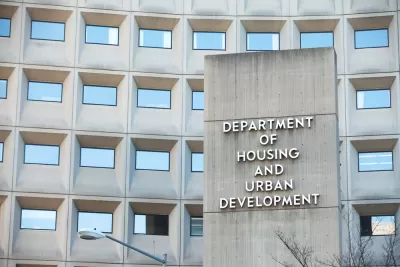
Five communities are receiving a combined $160 million in grants through the federal Choice Neighborhoods Initiative. The grant program is designed to "redevelop severely distressed housing and spur comprehensive revitalization," according to a U.S. Department of Housing and Urban Development press release announcing the winners of the most recent round of funding.
HUD named Camden, New Jersey; Cleveland, Ohio; Detroit, Michigan; Fort Myers, Florida; and Lewiston, Maine as this year’s grant winners. That means all five of the finalists announced in April received funding.
"The five awardees will create nearly 2,700 new mixed-income housing units as part of their efforts to revitalize their neighborhoods. Based on information provided in each community’s application, for every $1 in Choice Neighborhoods funding, the awardees will leverage an additional $10.60 in public and private resources for their project proposals," according to the press release.
A more detailed report provides more on the projects pursued by each of the grant winners. The city of Detroit's project, which won $30 million for the Greater Corktown neighborhood, attracted local media attention with a paywalled article published by Crain's Detroit Business. Here's how HUD's report describes that project:
With the award of the Choice Neighborhoods grant, the City of Detroit and its partners will replace the distressed 87-unit HUD-assisted Clement Kern Gardens Apartments with over 800 units of mixed-income housing. They will also enhance public spaces, integrate green infrastructure, and create a Community Empowerment Center. These physical investments will be paired with tailored health, employment, and education supports for the families living at Clement Kern Gardens Apartments.
FULL STORY: HUD AWARDS $160 MILLION TO 5 COMMUNITIES TO REVITALIZE HOUSING, INVEST IN NEIGHBORHOODS


New Federal Grant Rules Could Kill Detroit Road Diets
Millions in federal dollars for safe streets could be in jeopardy after federal agencies changed conditions for grant funding.
Judge Halts New Conditions for HUD, Transportation Grants
The Trump administration attempted to impose new restrictions on federal grants aimed at eliminating DEI programs and aligning with the administration’s immigration policy.
Shaping a 15-Minute City Vision for Detroit and Cleveland Using Data-Assisted Modeling
How master plans in the two cities hope to transform their historic, and historically underutilized, waterfronts.

Planetizen Federal Action Tracker
A weekly monitor of how Trump’s orders and actions are impacting planners and planning in America.

The state-sanctioned urbicide of Austin
People don’t kill cities. Freeways do.

US to reduce Colorado River water deliveries to Mexico
A new Colorado Treaty amendment reduces Mexico’s Colorado River water allocation by 250,000 acre feet.

5 New England states march closer to 800 megawatt wind energy project
Securing federal approval for the project may be complicated under the Trump administration, which has historically been hostile towards domestic wind power.

Baltimore to break ground on $50 million Transit Priority Project
The project will bring faster bus trips, safer streets and better bike connections to Baltimore.

Airbnb launches $250 million 'last-dollar financing' housing accelerator, makes first investment in Austin
The company will put $6.4 million towards affordable housing development in Texas’ capital.

FREE Course: Walkable City 1: Why Walkability?
After describing his path towards focusing on walkability as the essence of good planning, Jeff Speck marches through his five principal reasons for making more walkable places.
Reinventing Malls: Planning Alchemy—Turning Gray Fields Into Gold
The course focuses on the opportunities and imperatives that shape reinvention of mall sites.

Eagle County Government
Harvard University Graduate School of Design
Nashville Planning Department
The Architects Foundation
University of Cincinnati Online
The Pocatello Development Authority
The Urban Renewal Agency of the City of Pocatello
Journal of the American Planning Association