A report authored by Transportation for America and the American Public Transportation Association suggests that, no less than Social Security and Medicare, retiring baby boomers will have to cope with limited mobility options.


But this alone does not justify the agencies' plea for more funding, argues The Antiplanner:
"After decades of huge transit subsidies, per capita transit ridership today is no greater than it was in 1970–mainly because the subsidies have focused on extending transit service to those who don't need it rather than providing better service to those who do."
The solution, according to O'Toole? Spend more on increasing the current level of service in the central city areas where the demand for transit is consistently high instead of extending the routes en masse to the suburbs where public transit ridership is low.
Transportation for America has a blistering critique of O'Toole's analysis of their study, basically explaining that the report does not say what O'Toole claims it says.
Read the full story: The Myth of the Senior Transit Rider
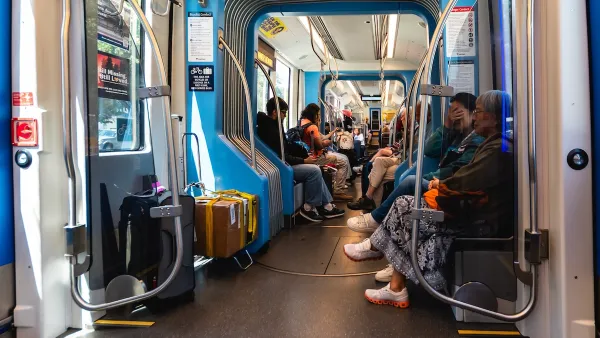
Voters choose public transit, approve $31 billion in funding
Approved projects include $101,000 for reduced-cost transit in a Michigan town and $14 billion for regional transit in the San Francisco Bay Area.
Analysis: What does America want from surface transportation reauthorization?
Over 13,000 comments were submitted in the federal Request for Information on surface transportation reauthorization. We analyzed all of them.
Follow Planetizen’s analysis of surface transportation reauthorization
Follow along as we explore the upcoming surface transportation reauthorization bill and its potential impacts on US transportation infrastructure in the coming years.

Desperate measures: Advocates weigh draining Lake Powell to fill Colorado River
Draining the reservoir could reduce evaporation losses by a couple hundred thousand acre-feet.

Eastern Nebraska is running out of electricity
Data centers and electrification are straining eastern Nebraska’s grid, throttling economic development.

Malls are becoming the midtowns of the future
Mall and office park redevelopments are a generational opportunity to create new nodes of urbanity.

NYC breaks ground on anti-flooding infrastructure project
New York City's new system will reduce stormwater flows to local sewers by 90%.

One Kentucky town’s secret to affordable housing
The Smoketown Community Land Trust has already built seven affordable homes for community members.

Houston gains petal-shaped cooling infrastructure to make streets more ‘delightful’
The city has installed the pavilions along 15 blocks in Houston.

FREE Course: Walkable City 1: Why Walkability?
After describing his path towards focusing on walkability as the essence of good planning, Jeff Speck marches through his five principal reasons for making more walkable places.
Reinventing Malls: Planning Alchemy—Turning Gray Fields Into Gold
The course focuses on the opportunities and imperatives that shape reinvention of mall sites.

City of Rosemead
Rutgers University, Edward J. Bloustein School of Planning and Public Policy
One Hundred Miles
University of Michigan School for Environment and Sustainability (SEAS)
Hunter College, City University of New York (CUNY)
The Architects Foundation
City of Cambridge
Montrose County
The Pocatello Development Authority