Social / Demographics
The Inputs Change, But Our Desire to Rank Places Never Wanes
Add a list of the "Top 100 Best Places to Live" to the seemingly endless series of rankings seeking to quantify what's best and worst about our cities and states. Though the inputs have changed over the last 80 years, our desire to rank hasn't.
Reconsidering Toronto's Suburbs
Toronto's suburbs have often been dismissed as bland and banal. A closer look, however, reveals a diverse, complex landscape whose rapid changes have profound implications for the metropolis as a whole.
Top 100 City Innovators Worldwide
To celebrate its first anniversary, Future Cities has assembled a list of the top 100 city innovators making the biggest difference across a range of industries and specialties.

Protecting San Francisco's Character Has Transformed It
By "protecting" San Francisco's physical character through down-zoning and NIMBY activism, the city has transformed its social character, as families, young adults, and others flee the city to find cheaper rents. A regional solution is required.
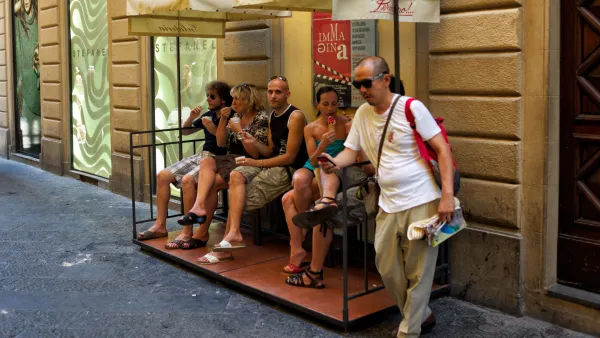
The Next Big Thing: "Sit-able Cities"
Supported by imagery of human urban conduct, Chuck Wolfe argues that walkable is good, but sit-able is better—and that "it’s time for the next big focal point and the next big idea, the 'Sit-able City'."
"Car-Free" Families on the Rise
Micheline Maynard writes about an AASHTO study showing that the share of American families who don't own cars had been declining since 1960 but stopped in 2007 at 8.7%. By 2011, it had budged up to 9.3%. She suggests four reasons for the reversal.
Architecture that Aims to Inspire a "Life With Purpose" for the Autistic
An estimated 79 percent of young adults with autism spectrum disorders reside with their parents. But a new residence built to house 16 autistic adults in Sonoma, CA aims to provide a supportive alternative to living at home, and a nationwide model.
Urban-Rural Rift in Colorado Results in Secession Vote
Come November, 11 of Colorado's 64 counties, mostly in northeast, will vote to form a new state. Jack Healy explores what's behind the 51st State Initiative, what set it off, as well as other secession movements, mostly by rural areas in the U.S.
Immigrants Help Revive Struggling Midwestern Cities
As the U.S. struggles once again to pass comprehensive immigration reform, Midwestern cities like Dayton, Ohio see attracting immigrants as the key to reversing population declines, reviving distressed neighborhoods, and boosting their economies.
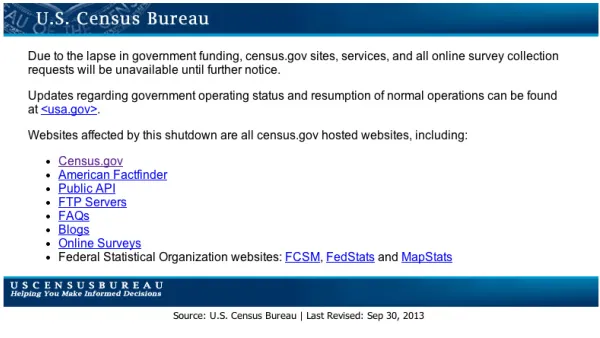
Where to Find Federal Data During the Shutdown
When the federal government shut down last week it took many agency websites along with it, depriving planners around the U.S. of resources they use daily. The blog Data Insights has put together a list of alternative sources for federal data.
How Can We Hype Downtown's Resurgence If We Can't Define It?
The U.S. Census Bureau uses a relatively crude definition of downtowns, complicating comparison between metros and opening up their findings to criticism. A new method of measuring downtowns via heat maps of job density aims to address this problem.
Next for Facebook: Building a Company Town
Last week, Facebook announced that it is working with a local developer to build a 394-unit housing complex adjacent to its campus in Menlo Park, California.
Bill de Blasio Unveils His Vision for Achieving an Affordable New York
Though his "Tale of Two Cities" was the centerpiece of Bill de Blasio's mayoral campaign, details on how the candidate plans to narrow New York City's rising inequality have been scarce. With a speech on Friday, he sought to fill in the gaps.
Toronto’s Vital Signs Wavering
Toronto’s 2013 Vital Signs Report cautions that while Canada’s largest city has a lot going for it, growing income disparity, high youth unemployment, and housing un-affordability threaten its future as one of the world’s most livable cities.

America's First Non-Profit Supermarket Provides a Model for Alleviating Food Deserts
Last weekend a new supermarket opened in Chester, Pennsylvania. But this isn't just another Safeway, Chester's groundbreaking non-profit supermarket could provide a model for areas across the country struggling to attract full-service grocers.
Population Growth and Prosperity Don't Go Hand in Hand
If your city isn't attracting hordes of new residents does that mean it's not growing economically? Richard Florida and his colleagues seek to undermine those who equate population growth with economic health.
Gentrification, Shmentrification
Despite media commentary about urban gentrification and the decline of suburbia, suburbs still have far less than a proportionate share of regional poverty.
Population Density and Political-Party Preference Appear To Be Linked
A new scatterplot mapping population density against political-party preference delivers old news: urban areas tend to lean Democratic, while rural places go Republican.
Is the Decline in Extreme Poverty the Greatest Achievement of the Past 50 Years?
Thanks to the efforts of donors, aid groups, and the economic development of countries like India and China, the number of people living in extreme poverty around the world has dropped significantly since 1980.
Top 10 Civic-Minded Companies
A ranking of the 10 most civic-minded companies holds some surprises -- mainly that the list is dominated by financial services firms.

FREE Course: Walkable City 1: Why Walkability?
After describing his path towards focusing on walkability as the essence of good planning, Jeff Speck marches through his five principal reasons for making more walkable places.
Reinventing Malls: Planning Alchemy—Turning Gray Fields Into Gold
The course focuses on the opportunities and imperatives that shape reinvention of mall sites.

City of Charlotte
City of Rosemead
Rutgers University, Edward J. Bloustein School of Planning and Public Policy
University of Michigan School for Environment and Sustainability (SEAS)
Hunter College, City University of New York (CUNY)
The Architects Foundation
University District Partnership









