Ginia Bellafante looks at the fate of a public housing project conceived with much fanfare in the early 1970s by progressive architects following the theory of 'Defensible Space' authored by architect and planner Oscar Newman.


"Mr. Newman’s work brought momentum to a movement, here and abroad, for more intimately conceived apartment buildings, especially for the poor, one of the most celebrated examples of which was Marcus Garvey Village, with 625 apartments, in Brownsville, Brooklyn," explains Bellafante. "Visiting Marcus Garvey today, it is nearly impossible to imagine the excitement that surrounded its groundbreaking 40 years ago, but it was born of thrilling alliances, as an exhibit at the Center for Architecture downtown, titled 'Low Rise High Density,' illustrates."
"The fate of Marcus Garvey Village is not addressed in the Center for Architecture’s show, but the sense of exuberant experimentation that attended the project could not insulate it from the problems of poverty that have troubled Brownsville for decades," Bellafante continues. "As one former official at the city’s Department of Housing Preservation and Development told me, Marcus Garvey actually makes the ailing towers of the Housing Authority so heavily concentrated in Brownsville 'look good.'”
Read the full story: A Housing Solution Gone Awry

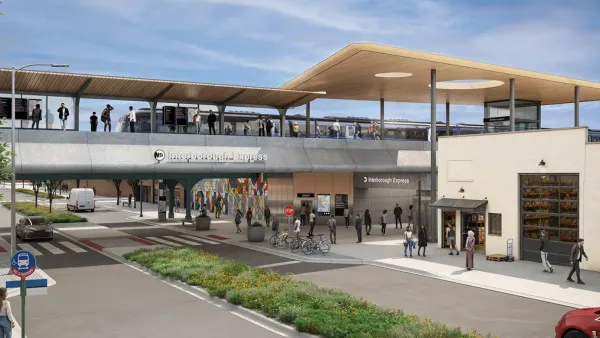
NYC releases new renderings for $5.5 billion Interborough Express
The slated stations will have a modern look, enhanced lighting and improved audio announcements.
NYC needs 700,000 new homes to resolve housing crisis, report states
The report gave every neighborhood a non-binding development target.
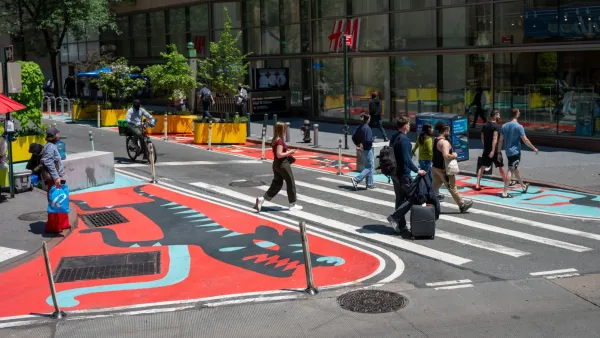
See Downtown Brooklyn’s Dramatic Complete Streets Transformation
A streetscape redesign spearheaded by the Downtown Brooklyn Partnership has quickly made many of Brooklyn’s streets unrecognizable.

Planetizen Federal Action Tracker
A weekly monitor of how Trump’s orders and actions are impacting planners and planning in America.

The state-sanctioned urbicide of Austin
People don’t kill cities. Freeways do.

US to reduce Colorado River water deliveries to Mexico
A new Colorado Treaty amendment reduces Mexico’s Colorado River water allocation by 250,000 acre feet.

Nation's most wind-powered state turns to coal as data centers increase energy demand
For the first time in decades, Iowa has increased its generation of coal power.

NYC cools commuters with city's first rain garden above a bus stop
New York City officials say the plants in the rain garden can absorb 16 gallons of rainwater during heavy storms.

Brightline West’s future may rely on $6 billion federal loan
The company has until Nov. 2 to make a $400 million equity investment into its proposed high-speed rail line.

FREE Course: Walkable City 1: Why Walkability?
After describing his path towards focusing on walkability as the essence of good planning, Jeff Speck marches through his five principal reasons for making more walkable places.
Reinventing Malls: Planning Alchemy—Turning Gray Fields Into Gold
The course focuses on the opportunities and imperatives that shape reinvention of mall sites.

Greater Baltimore Committee
Eagle County Government
Harvard University Graduate School of Design
The Architects Foundation
University of Cincinnati Online
The Pocatello Development Authority
The Urban Renewal Agency of the City of Pocatello
Journal of the American Planning Association