Regional planners and Dallas officials aren't confident that the area's highway-centric worldview (and budget) will change anytime soon. The city's competitiveness in the national job market may be on the line.


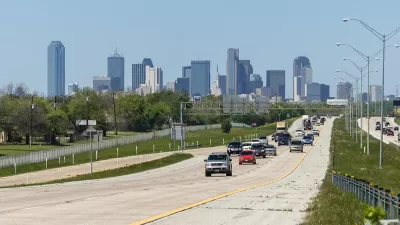
While Dallas has taken some steps to build out its transit grid, the region as a whole is still firmly situated in what one city councilman calls "transportation planning right out of the 1950s." Here, Brandon Formby discusses why North Texas' transportation planning seems stuck in a mode that favors intensive road construction.
Despite aiming to "give people alternatives to driving everywhere solo," the North Central Texas Council of Governments' Mobility 2045 plan is heavy on the highways. "Less than 3 percent of the $42.9 billion in traditional federal and state transportation revenues in the plan goes toward projects built for pedestrians and bicyclists; less than 1 percent goes toward public transit."
One prevalent problem is the fact that current behavior must be used to predict future needs, even when it's impossible to know how people will want to get around thirty years from now. Are young people driving because they want to, or because they "have had to etch out their lives atop metropolitan areas that were built around the automobile long before they were born?"
Meanwhile, "with no major geographic barriers like mountain chains or an ocean on the North Texas landscape, there are few natural obstacles to restrict the region's sprawl." Officials expect the familiar pattern of road construction and suburban development to continue.
See also: Highway Expansion Could Be Calamitous for Dallas' City Center
FULL STORY: Will Dallas Ever Favor the Neighborhood Over the Highway?


Resilience Planning for Suburban Growth
Whether or not the suburban shift accelerated by the pandemic continues, policymakers can implement climate resilience strategies and guide sustainable growth in both cities and exurbs.

Snowstorm That Stranded Thousands Prompts Questions About Auto-Centric Development
After thousands of motorists spent over a day on a snowbound Virginia highway, experts are warning that auto-centric sprawl will worsen the impacts of extreme weather events.
Dallas Brainstorms Multimodal Hub to Accompany High-Speed Rail
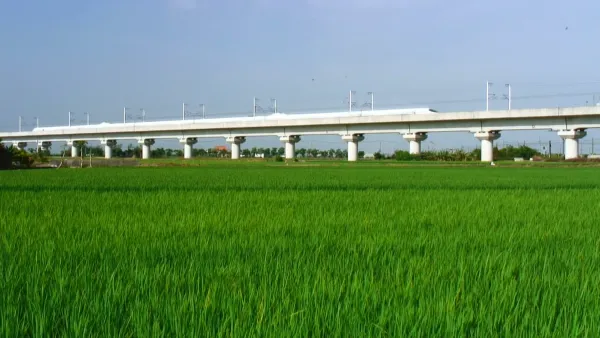
With a Dallas-Houston bullet train proposal proceeding apace, a complementary idea is now on the table: a multimodal transit hub linking Amtrak, transit, and even Hyperloop.

Planetizen Federal Action Tracker
A weekly monitor of how Trump’s orders and actions are impacting planners and planning in America.

The state-sanctioned urbicide of Austin
People don’t kill cities. Freeways do.

US to reduce Colorado River water deliveries to Mexico
A new Colorado Treaty amendment reduces Mexico’s Colorado River water allocation by 250,000 acre feet.

Mamdani overhauls NYC's Vision Zero plan with 100 new policy goals
The overhaul aims to reduce traffic deaths and make streets safer for pedestrians, cyclists and drivers through lower speed limits, new safety infrastructure and more.

Amtrak not solely to blame for New Jersey commuter rail's unreliability, report finds
A new study from the Garden State Initiative found that NJ Transit’s budget grew 20% across a 4 year period, but reliability declined significantly over the same period.

EPA erases limits on planet-warming pollution from power plants
Under Monday’s plan, power plants would still have some limits on how much mercury, arsenic and other contaminants they can emit.

FREE Course: Walkable City 1: Why Walkability?
After describing his path towards focusing on walkability as the essence of good planning, Jeff Speck marches through his five principal reasons for making more walkable places.
Reinventing Malls: Planning Alchemy—Turning Gray Fields Into Gold
The course focuses on the opportunities and imperatives that shape reinvention of mall sites.

Eagle County Government
Harvard University Graduate School of Design
Nashville Planning Department
The Architects Foundation
University of Cincinnati Online
The Pocatello Development Authority
The Urban Renewal Agency of the City of Pocatello
Journal of the American Planning Association