Three in 100 people in Portland are homeless.



"One in every two arrests made by the Portland Police Bureau last year was of a homeless person," report Rebecca Woolington and Melissa Lewis.
That conclusion followed analysis by the The Oregonian/OregonLive.
"The number of arrests is dramatically disproportionate to Portland's homeless population. People experiencing homelessness represent a tiny fraction of the city's overall population -- well below 3 percent even using the biggest estimates," explain Woolington and Lewis. "Yet in 2017, they accounted for 52 percent of arrests."
The statistics raise several questions. One is whether it is constitutional to criminalize homelessness with such stark severity. Another is about the costs to social welfare that police spend so much time dealing with such a small portion of the population. Another is whether this approach could possibly solve the problem. Tristia Bauman, senior attorney for the National Law Center on Homelessness & Poverty, is quoted in the article saying this response is "wholly ineffective."
According to the article, the number of arrests of homeless people "has grown amid calls from Portland business and neighborhood leaders for police to stop street-level crime, such as disorderly conduct and drug use, outside their front doors."
Read the full story: Portland homeless accounted for majority of police arrests in 2017, analysis finds

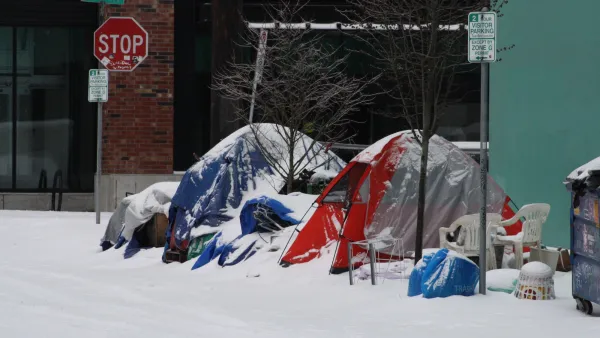
Portland Service Providers Say Mayor’s Methods for Ending Homelessness ‘Least Effective’
Experts say the mayor’s focus on overnight-only shelters fails to get people into long-term housing with the supportive services they need.
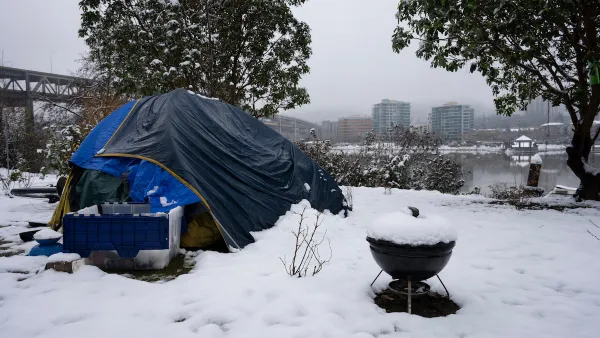
Portland Replaces Camping Ban With New Policy
Unhoused residents can sleep on public property when no shelter space is available, but still face penalties for violating new regulations or not moving into shelter if offered.
Portland Warming Shelters Close Despite Persistent Cold
Advocates say using an arbitrary temperature cutoff to open and close winter shelters ignores the reality of cold weather risks.

Planetizen Federal Action Tracker
A weekly monitor of how Trump’s orders and actions are impacting planners and planning in America.

Amtrak, CN end decades-long dispute with eight-year agreement
The new operating agreement establishes an updated framework for the companies to work together, including processes to resolve disputes.

Judges permit Denver to divert 77,000 acre feet from the Colorado River for reservoir expansion
Overuse and climate change have caused the Colorado River’s water levels to plummet.

NYC DOT wants faster, more permanent street upgrades
The city is examining ways to build more concrete infrastructure without getting entangled in 'decades-long' projects.

'Something we’ve never seen before:' rising utility rates could strain city finances nationwide
Data centers, climate change and other factors have caused utility rates in the United States to increase by 38% since 2020.

Trump to overrule local leaders, lease millions of acres of America’s Pacific Island territories’ seafloors to mining companies
International law says that the Indigenous people of America’s territories have a right to prior and informed consent regarding projects that impact their countries.

FREE Course: Walkable City 1: Why Walkability?
After describing his path towards focusing on walkability as the essence of good planning, Jeff Speck marches through his five principal reasons for making more walkable places.
Reinventing Malls: Planning Alchemy—Turning Gray Fields Into Gold
The course focuses on the opportunities and imperatives that shape reinvention of mall sites.

Harvard University Graduate School of Design
KFH Group Inc.
Greater Baltimore Committee
The Architects Foundation
University of Cincinnati Online
The Pocatello Development Authority
The Urban Renewal Agency of the City of Pocatello