Advocates say using an arbitrary temperature cutoff to open and close winter shelters ignores the reality of cold weather risks.


A decision by Multnomah County officials to shutter overnight winter shelters this week left hundreds of unhoused Portlanders out in the cold and other service providers scrambling to find alternate shelter options.
As Nicole Hayden explains in The Oregonian, “By policy, Multnomah County opens winter shelters when temperatures are forecast to dip to 25 degrees or below, if snow accumulation is forecast to reach an inch or more or if an inch or more of rain is forecast to fall overnight with temperatures are at or below 32 degrees. The thresholds must persist for four hours or occur between 8 p.m. and 7 a.m. to trigger shelter openings, according to the county.”
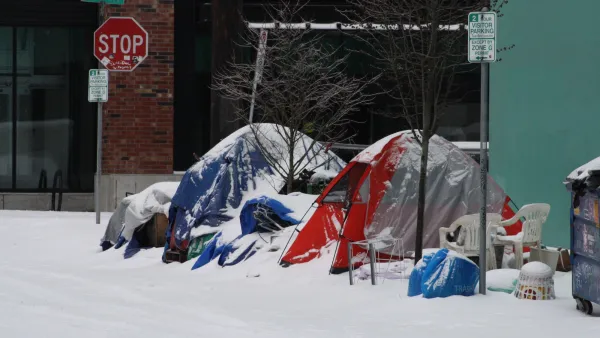
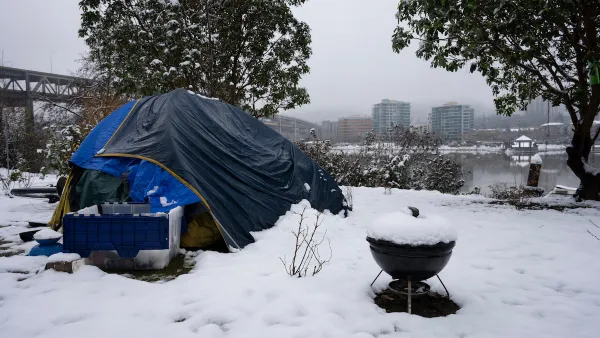
“Unhoused Portlanders, advocates and nonprofit leaders across the region expressed grave worry and frustration over the county’s decision to cut off access to safe spaces while wet, windy and icy conditions persisted.” People living outside face dangers ranging from hypothermia to the risk of fires and smoke inhalation inside tents.
FULL STORY: Unhoused Portlanders struggle amid icy conditions after shelters close

Portland Service Providers Say Mayor’s Methods for Ending Homelessness ‘Least Effective’
Experts say the mayor’s focus on overnight-only shelters fails to get people into long-term housing with the supportive services they need.
Portland Replaces Camping Ban With New Policy
Unhoused residents can sleep on public property when no shelter space is available, but still face penalties for violating new regulations or not moving into shelter if offered.
Seattle mayor pledges to build 500 shelter units by June
The Seattle Times editorial board expresses cautious optimism about the mayor's ambitious supportive housing plan.

The state-sanctioned urbicide of Austin
People don’t kill cities. Freeways do.

US to reduce Colorado River water deliveries to Mexico
A new Colorado Treaty amendment reduces Mexico’s Colorado River water allocation by 250,000 acre feet.

New Jersey’s second-largest city bans standalone data centers
Jersey City will continue to allow co-location facilities, such as those meant for research institutions that store their own data.

Amtrak not solely to blame for New Jersey commuter rail's unreliability, report finds
A new study from the Garden State Initiative found that NJ Transit’s budget grew 20% across a 4 year period, but reliability declined significantly over the same period.

EPA erases limits on planet-warming pollution from power plants
Under Monday’s plan, power plants would still have some limits on how much mercury, arsenic and other contaminants they can emit.

Phoenix announces new on-demand transit service, more frequent RAPID buses
Both new services will launch in October, and are part of Phoenix's Project Effective Access Solutions for Easing Congestion.

FREE Course: Walkable City 1: Why Walkability?
After describing his path towards focusing on walkability as the essence of good planning, Jeff Speck marches through his five principal reasons for making more walkable places.
Reinventing Malls: Planning Alchemy—Turning Gray Fields Into Gold
The course focuses on the opportunities and imperatives that shape reinvention of mall sites.

Eagle County Government
Harvard University Graduate School of Design
Nashville Planning Department
The Architects Foundation
University of Cincinnati Online
The Pocatello Development Authority
The Urban Renewal Agency of the City of Pocatello
Journal of the American Planning Association