A new report shows the need for Central Texas counties and cities to invest in their Latino populations.



Syeda Hasan reports: "Hispanic families in Central Texas don’t have the same opportunities to access health care, employment and early childhood education, according to a new report [pdf] from the Austin Community Foundation."
The report examined data on Latino residents from Travis, Williamson, Bastrop, Burnett, Caldwell and Hays counties. "They found the average per capita income in Central Texas is around $32,000, but for Latino residents, it’s about half that amount – just more than $17,000 a year," explains Hasan.
In addition to listing more of the report's findings, the article also surveys regional political leaders and advocates for insights about quality of life among Latino populations in Central Texas.
Notably, Hasan also describes the report as timed to coincide with the ongoing CodeNEXT process in Austin, which will rewrite the city's land development code. Austin City Councilmember Delia Garza is quoted in the article expressing her hope that discussions will move away from "protecting" neighborhoods. In Councilmember Garza's own words: "I think we should be protecting neighborhoods from fires and bears, maybe….But frankly, protecting neighborhoods has become a little bit offensive to me because what are we protecting them from? Families? Houses?"
Read the full story: Report Finds Gaps In Economic Opportunities For Hispanic Families In Central Texas
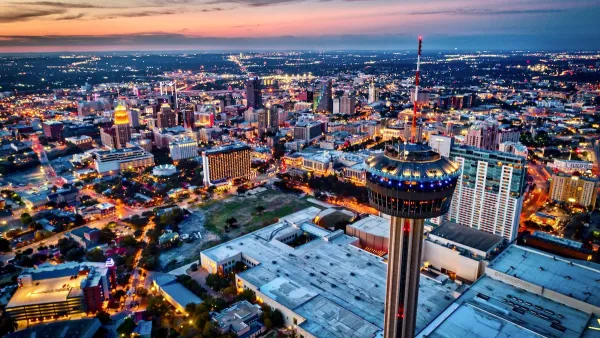
San Antonio and Austin are Fusing Into one Massive Megaregion
The region spanning the two central Texas cities is growing fast, posing challenges for local infrastructure and water supplies.

Toll and Tax, or Just Tax, to Pay for Highway Expansion?
A political decision by the Texas Transportation Commission last December to drop projects which included toll lanes was thought to doom 15 road expansions from their 10-year capital plan, but some will go forward with HOV as opposed to HOT lanes.

Breaking: Austin Moving on from CodeNEXT
The city of Austin's ambitious process of rewriting its Land Development Code has lost political support.

Planetizen Federal Action Tracker
A weekly monitor of how Trump’s orders and actions are impacting planners and planning in America.

California plans to bury El Niño’s downpour
If the state plays its cards right, it may be able to store a billion acre-feet of El Niño’s water in aquifers.

Desperate measures: Advocates weigh draining Lake Powell to fill Colorado River
Draining the reservoir could reduce evaporation losses by a couple hundred thousand acre-feet.

US buildings threatened, destroyed by fires set to triple by 2060
Researchers found a high fire risk for socioeconomically vulnerable neighborhoods in the American West.

LA residents may be allowed to paint their own crosswalks
Councilwoman Katy Yaroslavsky put out a motion instructing the Los Angeles Department of Public Transportation to study the feasibility of allowing volunteers to paint crosswalks.

Dallas moves to overhaul its zoning code
The city's zoning reform will allow more multi-family and mixed-use developments.

FREE Course: Walkable City 1: Why Walkability?
After describing his path towards focusing on walkability as the essence of good planning, Jeff Speck marches through his five principal reasons for making more walkable places.
Reinventing Malls: Planning Alchemy—Turning Gray Fields Into Gold
The course focuses on the opportunities and imperatives that shape reinvention of mall sites.

City of Rosemead
Rutgers University, Edward J. Bloustein School of Planning and Public Policy
One Hundred Miles
Hunter College, City University of New York (CUNY)
The Architects Foundation
University of Cincinnati Online
City of Cambridge
Montrose County
The Pocatello Development Authority