Exploring the surprising origins of the American suburbs.


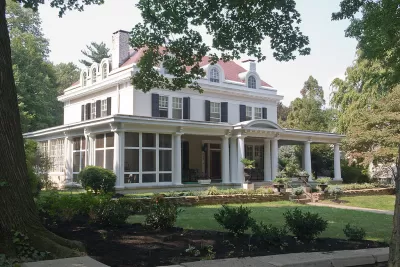
Paige Glotzer examines the history of exclusionary housing in a big, interactive post on the Harvard Faculty of Arts and Sciences website. The article traces the history from the 1890s, with the rise of segregated planned suburbs in the United States made possible by British investments, through the 1960s, where the legacy of one company's investments was still evident in Baltimore.
"Suburbs may seem uniquely American, yet Caribbean slavery, British industrialization, imperialism, and even the battles for women’s rights all directly affected who invested in them and where the capital came from," according to Glotzer. "Egypt, India, Antigua, the Congo served as some of the other sources of wealth for those who financed America’s segregated suburbs."
Glotzer also explains the significance of this history: "determining who bankrolled the start of modern American housing segregation sharpens our understanding of why exclusion assumed particular forms and allowed people—such as developers and certain homeowners—to stake new claims to power."
The article presents numerous historic documents, infographics, and Esri storymaps in an interactive feature.
FULL STORY: The Business of Exclusionary Housing Markets, 1890-1960


First Model Homes Revealed in Disney-Built Community
Disney’s Cotino, in the Southern California desert, is the first of the company’s ‘Storybook Living’ developments.

Friday Funny: Gated Community Doubles Down
The Onion skewers suburbia.
Is Exclusionary Zoning a Good Thing?
Some commentators defend exclusionary suburban zoning on the ground that it makes affluent suburbanites more willing to pay for public services. But does exclusion create losers?

Planetizen Federal Action Tracker
A weekly monitor of how Trump’s orders and actions are impacting planners and planning in America.

The state-sanctioned urbicide of Austin
People don’t kill cities. Freeways do.

US to reduce Colorado River water deliveries to Mexico
A new Colorado Treaty amendment reduces Mexico’s Colorado River water allocation by 250,000 acre feet.

Mamdani overhauls NYC's Vision Zero plan with 100 new policy goals
The overhaul aims to reduce traffic deaths and make streets safer for pedestrians, cyclists and drivers through lower speed limits, new safety infrastructure and more.

Amtrak not solely to blame for New Jersey commuter rail's unreliability, report finds
A new study from the Garden State Initiative found that NJ Transit’s budget grew 20% across a 4 year period, but reliability declined significantly over the same period.

EPA erases limits on planet-warming pollution from power plants
Under Monday’s plan, power plants would still have some limits on how much mercury, arsenic and other contaminants they can emit.

FREE Course: Walkable City 1: Why Walkability?
After describing his path towards focusing on walkability as the essence of good planning, Jeff Speck marches through his five principal reasons for making more walkable places.
Reinventing Malls: Planning Alchemy—Turning Gray Fields Into Gold
The course focuses on the opportunities and imperatives that shape reinvention of mall sites.


Eagle County Government
Harvard University Graduate School of Design
Nashville Planning Department
The Architects Foundation
University of Cincinnati Online
The Pocatello Development Authority
The Urban Renewal Agency of the City of Pocatello
Journal of the American Planning Association