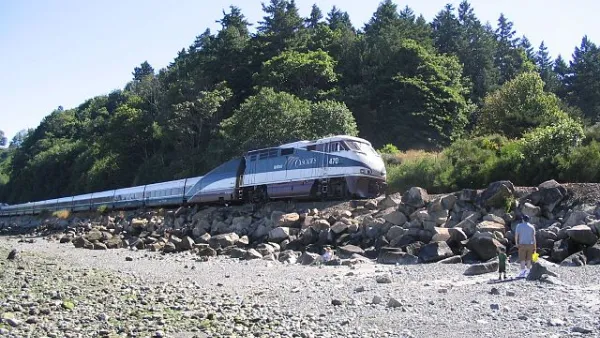
The cause of last month's deadly Amtrak crash south of Tacoma above Interstate 5 is attributed to the train traveling at 78 mph through a curve with a speed limit of 30 mph. The original plan for the bypass called for the elimination of that curve.


Much attention has been placed on the lack of an operational positive train control system which could potentially have prevented Amtrak Cascades #501 on its maiden voyage on Dec. 18 from speeding through a curve leading to a bridge over Interstate 5 where it derailed, with two cars falling onto the freeway below, killing three passengers and injuring over 100. Now attention is being placed on the curve itself.
On Dec. 22, Ted Mann of The Wall Street Journal reported that had the Washington State Department of Transportation (WSDOT) proceeded with their original plan for the bypass route, that curve would never have existed. Amanda Woods of the New York Post reports on Mann's piece (which is accessible only to WSJ subscribers).
"An $11 billion Washington State government plan to speed up passenger and freight rail service throughout the Pacific Northwest called for an elimination of the turn," reports Woods.
But that request was not included in the final design, once the state won federal funding for the [$180.7 million] Point Defiance railroad bypass south of Tacoma, Wash., The Wall Street Journal reported on [Dec. 22].
The plan was ditched because the turn in question was deemed too costly to remove, the outlet reported, citing documents and state officials.
The section where the train derailed “includes unsuitable sharp curvature,” according to schematic documents obtained by the paper.
Woods adds that while WSDOT has plans to improve the bypass route to increase speed, they do not include elimination of the deadly curve "because it wasn’t deemed necessary to support the number of round trips the state and Amtrak had planned for the corridor," a WSDOT spokeswoman told the the Journal.
According to WSDOT, trains will not use the bypass route or the new Tacoma station for the foreseeable future due to the Dec. 18 derailment.
Also on Dec. 22, the National Transportation Safety Board issued a press release based on "Initial Review of Amtrak Train Recorders."
About six seconds prior to the derailment, the engineer made a comment regarding an over speed condition.
Some experts have suggested the engineer was distracted, possible due to the presence of someone else in the cab. The term they use is "loss of situational awareness."
FULL STORY: Train track was never supposed to have deadly curve

Focus on Positive Train Control after Amtrak Train 501 Derails in Washington
Excessive speed is thought to be the cause of the deadly derailment on Dec. 18. Positive train control, which likely would have slowed down the train, was installed on the tracks and locomotive but was not yet operational.
Amtrak Suffers Third Fatal Crash in Less than Two Months
The crash in Cayce, South Carolina on Sunday killed the engineer and conductor riding in the Amtrak locomotive, injuring over 100 passengers and crew members. A locked switch had directed Amtrak #91 into a siding where it hit a parked CSX train.
*New Amtrak Train Derails On Highway Overpass Outside of Seattle, Killing 3
The first southbound train on of the newly routed Amtrak Cascades Seattle-to-Portland service derailed on a highway overpass on Monday morning, with two passenger cars falling onto southbound Interstate 5, striking motor vehicles.

The state-sanctioned urbicide of Austin
People don’t kill cities. Freeways do.

US to reduce Colorado River water deliveries to Mexico
A new Colorado Treaty amendment reduces Mexico’s Colorado River water allocation by 250,000 acre feet.

New Jersey’s second-largest city bans standalone data centers
Jersey City will continue to allow co-location facilities, such as those meant for research institutions that store their own data.

Amtrak not solely to blame for New Jersey commuter rail's unreliability, report finds
A new study from the Garden State Initiative found that NJ Transit’s budget grew 20% across a 4 year period, but reliability declined significantly over the same period.

EPA erases limits on planet-warming pollution from power plants
Under Monday’s plan, power plants would still have some limits on how much mercury, arsenic and other contaminants they can emit.

Phoenix announces new on-demand transit service, more frequent RAPID buses
Both new services will launch in October, and are part of Phoenix's Project Effective Access Solutions for Easing Congestion.

FREE Course: Walkable City 1: Why Walkability?
After describing his path towards focusing on walkability as the essence of good planning, Jeff Speck marches through his five principal reasons for making more walkable places.
Reinventing Malls: Planning Alchemy—Turning Gray Fields Into Gold
The course focuses on the opportunities and imperatives that shape reinvention of mall sites.

Eagle County Government
Harvard University Graduate School of Design
Nashville Planning Department
The Architects Foundation
University of Cincinnati Online
The Pocatello Development Authority
The Urban Renewal Agency of the City of Pocatello
Journal of the American Planning Association