Ridership on Water Emergency Transportation Authority ferries, which operate around the San Francisco Bay, has grown 78 percent since 2012. Investment in new and expanded facilities is preparing for even more growth.


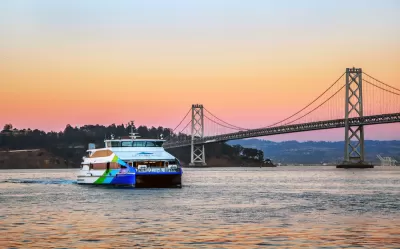
J.K. Dineen reports on the ongoing process of expanding ferry service in the San Francisco Bay Area, thanks to work underway at multiple Water Emergency Transportation Authority facilities.
"The $74 million expansion of the ferry terminal [in San Francisco], with the first phase set to be completed late next year, will triple the number of ferries that can stream in and out of downtown San Francisco," according to Dineen. The investment "will also create the infrastructure needed for new routes to Richmond, Treasure Island, Berkeley, Redwood City and San Francisco’s Mission Bay," and "[t]he terminal in Richmond is under construction while the others are in the planning stages."
Planetizen last checked in with local coverage of ferry service as a public transit option in the Bay Area back in April 2016.
Read the full story: SF Bay ferry service on brink of major expansion

BART Closes $35 Million Deficit
Cost control and revenue generation measures prevented service cuts.
One Rail System to Ring the Bay Area? Supporters See Reasons for Optimism
A plan to integrate the various regional transit providers in the San Francisco Bay Area could be the key to winning back transit riders in the post-pandemic world.
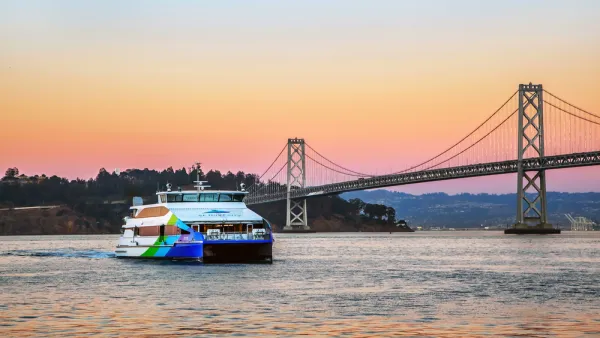
San Francisco Ferry Launches New Commuter Line
The San Francisco Bay ferry system is growing as commuters flee congested roads and overcrowded BART cars.

Planetizen Federal Action Tracker
A weekly monitor of how Trump’s orders and actions are impacting planners and planning in America.

California plans to bury El Niño’s downpour
If the state plays its cards right, it may be able to store a billion acre-feet of El Niño’s water in aquifers.

Desperate measures: Advocates weigh draining Lake Powell to fill Colorado River
Draining the reservoir could reduce evaporation losses by a couple hundred thousand acre-feet.

Mamdani’s pied-à-terre tax survives legal challenge
A panel of judges found that the plaintiffs failed to demonstrate injury as a result of New York City's implementation of the tax.

Eastern Nebraska is running out of electricity
Data centers and electrification are straining eastern Nebraska’s grid, throttling economic development.

Seattle passes record-breaking transit services expansion
Proposition 1 will double the city’s transit tax to add 95,000 more bus trips and preserve 180,000 bus trips annually.

FREE Course: Walkable City 1: Why Walkability?
After describing his path towards focusing on walkability as the essence of good planning, Jeff Speck marches through his five principal reasons for making more walkable places.
Reinventing Malls: Planning Alchemy—Turning Gray Fields Into Gold
The course focuses on the opportunities and imperatives that shape reinvention of mall sites.

City of Rosemead
Rutgers University, Edward J. Bloustein School of Planning and Public Policy
One Hundred Miles
University of Michigan School for Environment and Sustainability (SEAS)
Hunter College, City University of New York (CUNY)
The Architects Foundation
City of Cambridge
Montrose County
The Pocatello Development Authority