A particularly frustrating 1.2-mile stretch became a whole lot smoother when simple orange cones turned a parking lane and a bike lane into a lane for buses.


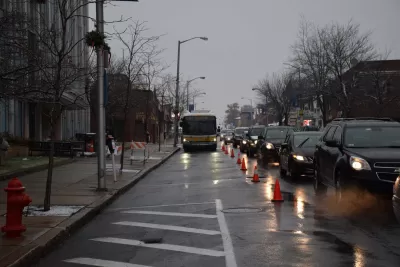
In Boston, the tricks of "tactical urbanism" are coming in handy for legitimate transit operators. Regarding one snarled stretch, Angie Schmitt writes, "The intense traffic congestion can drag out the approximately 1.2 mile-long trip between Roslindale Square and the Forest Hills Orange Line station as long as 45 minutes."
But in a recent trial run, "Bus riders got a dramatically faster ride thanks to a one-day pilot in which Boston DOT and the MBTA converted a parking lane and a bike lane into a bus lane using just orange cones."
The improvised bus lane was a hit, shaving around 30 minutes from many riders' commutes. "This is an incredibly cost-effective way to move more people more efficiently along our streets without the time and resources required for capital projects," remarked Andrew McFarland of Boston's LivableStreets Alliance. Similar and longer experiments of the same kind are planned for the new year.
Read the full story: Boston Tests Faster Bus Service Simply By Laying Out Orange Cones

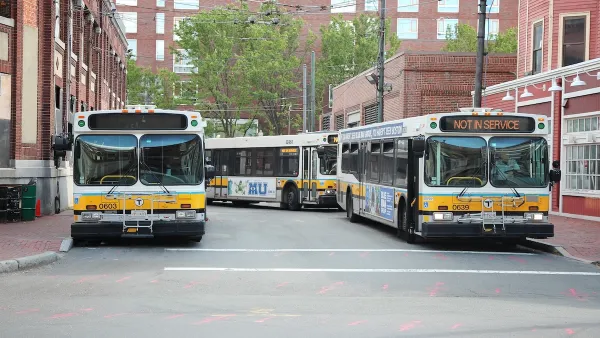
Boston Bus Signal Priority Project Yields Faster Travel Times
The city now plans to expand a year-long pilot project that reduced the time buses waited at traffic signals.
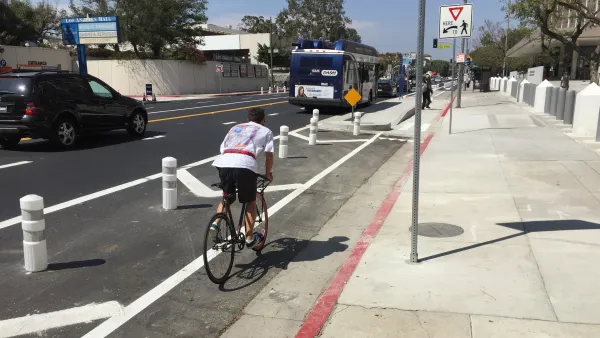
Opinion: Los Angeles Must Prioritize Bikes and Buses
L.A. has a plan for improving mobility. Why are city leaders ignoring it?
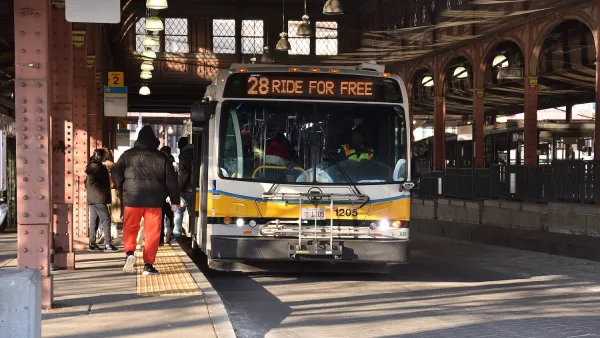
Boston’s Free Buses are Also its Slowest
Two fare-free bus lines have seen a sharp increase in travel times.

Planetizen Federal Action Tracker
A weekly monitor of how Trump’s orders and actions are impacting planners and planning in America.

California plans to bury El Niño’s downpour
If the state plays its cards right, it may be able to store a billion acre-feet of El Niño’s water in aquifers.

Chicago breaks ground on $3 billion megadevelopment
The new neighborhood, titled Foundry Park, will one day host 3,700 residences.

Satanic Place Names
From streams and lakes to valleys and canyons, I mapped more than 1,000 places named after the Devil.

California High-Speed Rail Authority CEO resigns after $600,000 scandal
Under Ian Choudri, the authority used taxpayer dollars to fund first class flights and trips to nightclubs.

Want to study the Missouri River? Soon, you may need unanimous approval from 10 states
Legislation would require 10 governors’ permission to study or build projects moving water outside the basin.

FREE Course: Walkable City 1: Why Walkability?
After describing his path towards focusing on walkability as the essence of good planning, Jeff Speck marches through his five principal reasons for making more walkable places.
Reinventing Malls: Planning Alchemy—Turning Gray Fields Into Gold
The course focuses on the opportunities and imperatives that shape reinvention of mall sites.

City of Rosemead
Rutgers University, Edward J. Bloustein School of Planning and Public Policy
One Hundred Miles
Hunter College, City University of New York (CUNY)
The Architects Foundation
University of Cincinnati Online
City of Cambridge
Montrose County
The Pocatello Development Authority