The Northern Michigan Sports Commission hasn't even been created yet, but it already has funding clout in the state government.


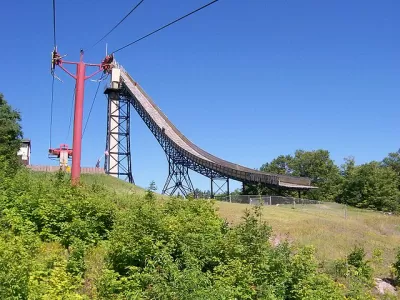
A committee in the Michigan House of Representatives approved a bill that would move financing around—benefitting the change would be a ski jump at Copper Peak in the city of Ironwood.
"The $1.9 million annual shift of funds would go into a Northern Michigan Sports Commission that hasn't been created yet, but would award grants to recreation projects across northern Michigan," report Kathleen Gray. "The bulk of the first year's tax shift would go to Copper Peak."
Gray adds that the $1.9 million was previously earmarked for improvements at the Cobo Center, a convention center located in Downtown Detroit, so the move has attracted controversy. "Democrats, Cobo Center officials, and the county executives of Wayne, Oakland and Macomb counties oppose the bill, saying that any diversion of money from Cobo's coffers could slow the convention center's recovery, just as the facility is beginning to operate in the black."
Supporting the shift in funding priorities, however, are "Upper Peninsula entrepreneurs and lawmakers who are hoping the money can be used to make improvements to the Copper Peak ski jump so it can become an attraction for world-class athletes and Olympians." The ski jump facility at Copper Peak last operated in 1994.
Read the full story: House panel votes to give $1.9 million in Cobo cash to Upper Peninsula ski jump hill

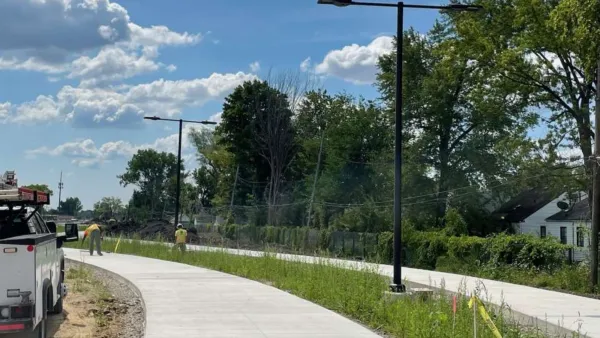
Detroit greenway brings revival — and fears of displacement
The planned Joe Louis Greenway is already bringing change to the neighborhoods near it.
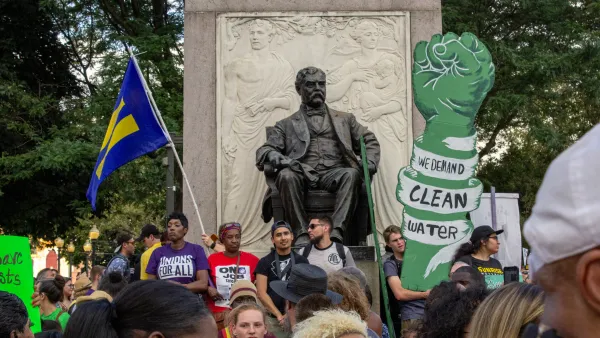
Some Detroit residents spend as much as 25% of their disposable income on water bills. A fraught history explains why.
Detroit’s water affordability crisis is tied to the uneven distribution of stormwater management costs.
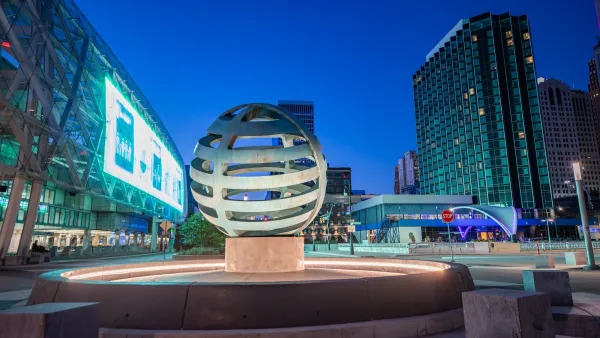
APA conference draws 4,000 urban planners to Detroit this weekend
The annual conference brings together planners for a weekend of panels, discussions and tours.

Planetizen Federal Action Tracker
A weekly monitor of how Trump’s orders and actions are impacting planners and planning in America.

Amtrak, CN end decades-long dispute with eight-year agreement
The new operating agreement establishes an updated framework for the companies to work together, including processes to resolve disputes.

Judges permit Denver to divert 77,000 acre feet from the Colorado River for reservoir expansion
Overuse and climate change have caused the Colorado River’s water levels to plummet.

NYC DOT wants faster, more permanent street upgrades
The city is examining ways to build more concrete infrastructure without getting entangled in 'decades-long' projects.

'Something we’ve never seen before:' rising utility rates could strain city finances nationwide
Data centers, climate change and other factors have caused utility rates in the United States to increase by 38% since 2020.

Trump to overrule local leaders, lease millions of acres of America’s Pacific Island territories’ seafloors to mining companies
International law says that the Indigenous people of America’s territories have a right to prior and informed consent regarding projects that impact their countries.

FREE Course: Walkable City 1: Why Walkability?
After describing his path towards focusing on walkability as the essence of good planning, Jeff Speck marches through his five principal reasons for making more walkable places.
Reinventing Malls: Planning Alchemy—Turning Gray Fields Into Gold
The course focuses on the opportunities and imperatives that shape reinvention of mall sites.


Harvard University Graduate School of Design
KFH Group Inc.
Greater Baltimore Committee
The Architects Foundation
University of Cincinnati Online
The Pocatello Development Authority
The Urban Renewal Agency of the City of Pocatello