A handful of Delray residents refuse to be displaced by industry, but the plan for a new bridge may mean they don't have a choice.


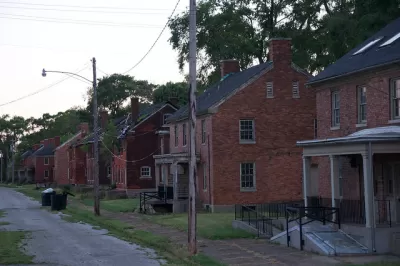
“Years ago, Delray was sentenced to die,” John Carlisle writes in a lengthy essay that amounts to a profile of this shrinking neighborhood in Detroit.
“In a city with plenty of rough neighborhoods, Delray is regarded as one of the worst. It’s been called Detroit’s backwater, its underbelly, the bowels of the region — which it literally is, in a sense, since the city’s wastewater treatment plant is here, receiving and incinerating the contents of everyone’s toilets in Detroit and 77 surrounding communities and filling the air for miles with a God-awful stink.”
The city has long hoped that residents will move away from Delray on their own, leaving an industrial zone, but in interviews with the handful of residents still living there, Carlisle finds deep ties to a place where members of the same family occupy neighboring houses.
Recent reports on Detroit have focused on the palpable, if uneven, recovery of the city, and Delray’s condition is, in a sense, the dark side of “rebirth,” as interest in emptying the neighborhood has become urgent.
“Now, the city is trying one more time to convince them to go. The long-planned new bridge to Canada, and the 170-acre customs plaza that will spread outward from the bridge’s footprint will wipe out much of the old neighborhood, splitting what’s left into two isolated pockets of semi-empty blocks. Those who choose to stay will be subject to a whole new level of noise and pollution. So the city is making an unprecedented offer to give residents another house someplace else in the city for free, plus a whole bunch of money to fix it up.”
Carlisle’s deeply reported piece looks at the history, geography, and demographics of a place that has both changed and stayed the same.
“Those left here say they feel under siege — by a city trying for years to get them to leave, by factories and industrial plants polluting their air, by criminals using their neighborhood to commit crimes in secret. But residents also speak of a bond in their shared isolation, a defiance toward those who look down on them as hayseeds, and a sense of anarchy and freedom that — for better or worse — can’t normally be found in a big city like Detroit.”
FULL STORY: Is this the end of Delray?

Mayor Duggan Lays Out Eight Principles for Detroit's Redevelopment
Detroit Mayor Mike Duggan made a splash this week by pronouncing a vision to create a Detroit that is 'one city for all of us.'
Construction Details, Costs Emerge for Gordie Howe International Bridge
A plan to build the nation's longest cable-stayed bridge has been busy clearing benchmarks this summer.
Judge Clears the Way for Gordie Howe International Bridge in Detroit
The Michigan Department of Transportation ran into a powerful obstacle when acquiring land for a new bridge between Detroit and Windsor, Canada, but a county judge sided with the state.

Planetizen Federal Action Tracker
A weekly monitor of how Trump’s orders and actions are impacting planners and planning in America.

The state-sanctioned urbicide of Austin
People don’t kill cities. Freeways do.

US to reduce Colorado River water deliveries to Mexico
A new Colorado Treaty amendment reduces Mexico’s Colorado River water allocation by 250,000 acre feet.

5 New England states march closer to 800 megawatt wind energy project
Securing federal approval for the project may be complicated under the Trump administration, which has historically been hostile towards domestic wind power.

Baltimore to break ground on $50 million Transit Priority Project
The project will bring faster bus trips, safer streets and better bike connections to Baltimore.

Airbnb launches $250 million 'last-dollar financing' housing accelerator, makes first investment in Austin
The company will put $6.4 million towards affordable housing development in Texas’ capital.

FREE Course: Walkable City 1: Why Walkability?
After describing his path towards focusing on walkability as the essence of good planning, Jeff Speck marches through his five principal reasons for making more walkable places.
Reinventing Malls: Planning Alchemy—Turning Gray Fields Into Gold
The course focuses on the opportunities and imperatives that shape reinvention of mall sites.

Eagle County Government
Harvard University Graduate School of Design
Nashville Planning Department
The Architects Foundation
University of Cincinnati Online
The Pocatello Development Authority
The Urban Renewal Agency of the City of Pocatello
Journal of the American Planning Association