The recent spill of 210,000 gallons of crude oil from the Keystone pipeline in South Dakota was far from an outlier.


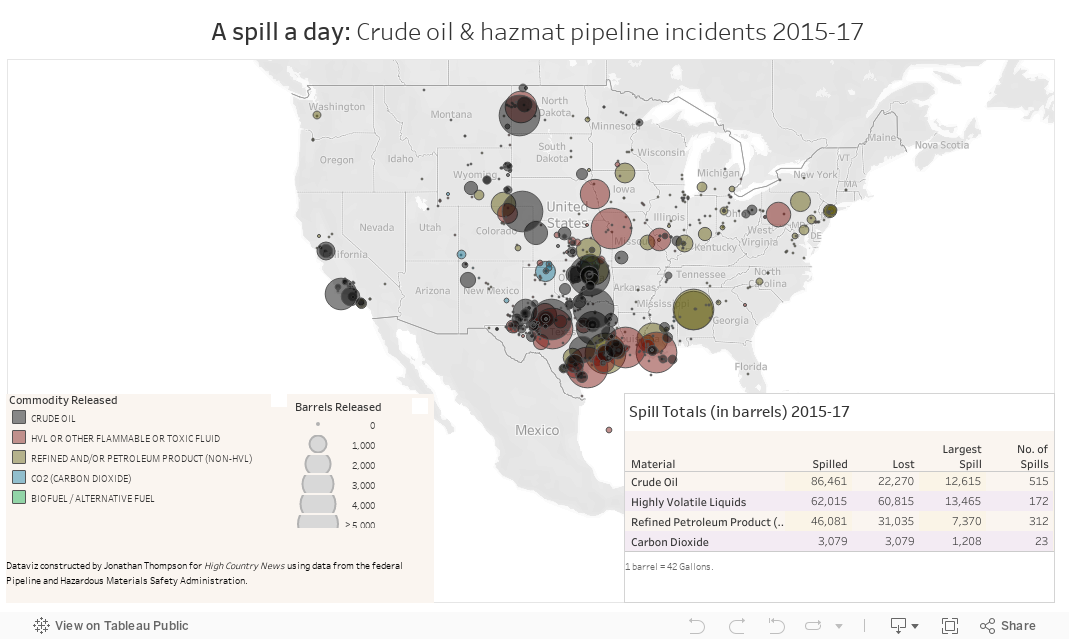
Jonathan Thompson follows the news from earlier in the week that the Nebraska Public Service Commission had authorized the Keystone XL oil pipeline through the state by presenting on infographic that illustrates the scale of the environmental threat represented by oil pipelines.
"Pipelines are often touted as safer than train or truck for transporting oil and other hazardous materials. But over the last two-and-a-half years, crude oil and hazardous materials pipelines across the U.S. busted at a rate of more than once per day, through corrosion, floods, lightning, vehicles and vandals," writes Thompson.
"Some 3.6 million gallons of crude oil spilled in total, and five oil spills were as large or larger than the Keystone incident," writes Thompson, referring to an incident earlier in November that spilled 5,000 barrels, or 210,000 gallons, of crude oil from the Keystone Pipeline in South Dakota.
To illustrate this point, Thompson also shares the infographic shown below, which gathers all the crude oil spills between 2015 and 2017 onto one busy map of the United States.
FULL STORY: Nationwide, oil pipeline spills are a near-daily reality

Tar Sands Oil Just Lost Another Outlet, For Now
It was viewed as a "David vs. Goliath" pipeline fight: the city of South Portland, Maine against a pipeline company backed by Big Oil. The city had passed a zoning ordinance preventing the export of oil which would have impacted public health.
Keystone Pipeline Leaks Oil in Advance of Crucial Decision on Sister Pipeline
Thursday's massive oil spill in South Dakota is not a good omen for TransCanada for a favorable decision on Monday on an application before the Nebraska Public Service Commission on the routing of the controversial Keystone XL pipeline.
The Geography of Oil and Gas Pipeline Accidents [Updated]
Safety is one trigger in the heated debate over whether fossil fuels should be transported by pipeline. While the industry insists the method is safer than others, the spread of accidents since 1986 is substantial.

The state-sanctioned urbicide of Austin
People don’t kill cities. Freeways do.

US to reduce Colorado River water deliveries to Mexico
A new Colorado Treaty amendment reduces Mexico’s Colorado River water allocation by 250,000 acre feet.

New Jersey’s second-largest city bans standalone data centers
Jersey City will continue to allow co-location facilities, such as those meant for research institutions that store their own data.

Amtrak not solely to blame for New Jersey commuter rail's unreliability, report finds
A new study from the Garden State Initiative found that NJ Transit’s budget grew 20% across a 4 year period, but reliability declined significantly over the same period.

EPA erases limits on planet-warming pollution from power plants
Under Monday’s plan, power plants would still have some limits on how much mercury, arsenic and other contaminants they can emit.

Phoenix announces new on-demand transit service, more frequent RAPID buses
Both new services will launch in October, and are part of Phoenix's Project Effective Access Solutions for Easing Congestion.

FREE Course: Walkable City 1: Why Walkability?
After describing his path towards focusing on walkability as the essence of good planning, Jeff Speck marches through his five principal reasons for making more walkable places.
Reinventing Malls: Planning Alchemy—Turning Gray Fields Into Gold
The course focuses on the opportunities and imperatives that shape reinvention of mall sites.

Eagle County Government
Harvard University Graduate School of Design
Nashville Planning Department
The Architects Foundation
University of Cincinnati Online
The Pocatello Development Authority
The Urban Renewal Agency of the City of Pocatello
Journal of the American Planning Association