Research in cognitive sciences is dictating that we can no longer rely on the presentation of scientific facts when building policy.



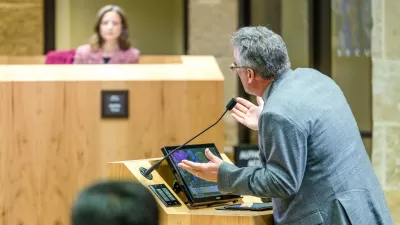
You're up there presenting to council the policy you just developed. You're confident in your baby: it's evidence-based, after all. You probably even wrote that in your report. You did your background research, accumulated and consolidated information. You poured over it and whittled down the data into tight policy statements. You completed what's considered the "problem-oriented approach" to writing policy. There was a gap, a problem. You resolved it. That's what your policy is based on. It's likely a failure.
Recently, a paper in the Policy Sciences journal used research in cognitive sciences to more fully understand the multifaceted nature of developing policy. The authors, Cairney and Weible, convey that the evidence-based approach to policy development does not consider the "too-messy link between cognitive and contextual explanations for action."
We've long understood that there's a limit to what we can research to develop policy. Only recently, state Cairney and Weible, have we begun to draw on social and organizational psychology to understand how emotions act as informational short cuts and coexist with cognition. We're learning the importance of group processes in leveraging emotional decision-making over rational thought.
A policy scientist analyzing the literature in her field of research may understand its various dimensions and produce recommendations based on it, but the myriad contexts, including her own (ir)rationality, in which the policy is contextualized cannot be fully considered. This should be expected. As Cairney and Weible state, "Our value orientations change following interactions with people who reinforce or challenge our beliefs." We frame our research and are led by those principles as we prioritize the goals of our research.
The authors continue: "A policymaker's environment consists of a myriad of actors and factors: multiple policymakers and influencers spread across levels and types of government; the formal and informal institutions that guide their actions at each level; the networks they form; the ideas of beliefs that dominate the ways in which they think about problems and solutions; the biophysical and socio-economic conditions to which they respond; and the events that offer opportunities and shocks."
What's the result? The authors suggest its tempting to assume we know what makes our audience tick, but policy operates in a context outside the influence of any one person; it's influenced by the crowd. There are many ticks. Thus there's a balance between the rational need of evidence and irrational reality of where decisions about policy are made. We should be making "good enough" decisions in our policy prescriptions. We don't need to seek a rationally perfect depiction of reality.
"If people engage emotionally with information, there is no way to appeal to all audiences with the same information." What are the lessons for developing policy? We're storytellers. Policy authors should tell a simple story with a clear moral, be trustworthy and consider the power structures of politics. We should accept that developing policy is ultimately an output of irrationality (read, political). It isn't an objective relay of evidence.
Ultimately, the authors conclude, "the choice is not whether or not to focus on skillful persuasion which appeals to emotion, but how to do it most effectively while adhering to key ethical principles. Generating trust in the messenger and knowing your audience may be more important to success than presenting evidence."


Minneapolis Activists Use DIY Traffic Circles to Identify, Slow ICE
Residents are using the pop-up roundabouts to slow traffic and make their presence known on Minneapolis streets.
Reclaiming Transportation as a Place of Resistance
The systems that move us are not neutral — and we don’t have to pretend like they are.

Red Cities, Blue Cities and (Property) Crime: A Sequel
Like urban violent crime, urban property crime is often a political football. Republicans claim that crime in Democrat-run cities is proof that Democrats are incapable of maintaining public order. Do they have a point?

Planetizen Federal Action Tracker
A weekly monitor of how Trump’s orders and actions are impacting planners and planning in America.

Amtrak, CN end decades-long dispute with eight-year agreement
The new operating agreement establishes an updated framework for the companies to work together, including processes to resolve disputes.

Judges permit Denver to divert 77,000 acre feet from the Colorado River for reservoir expansion
Overuse and climate change have caused the Colorado River’s water levels to plummet.

NYC DOT wants faster, more permanent street upgrades
The city is examining ways to build more concrete infrastructure without getting entangled in 'decades-long' projects.

'Something we’ve never seen before:' rising utility rates could strain city finances nationwide
Data centers, climate change and other factors have caused utility rates in the United States to increase by 38% since 2020.

Trump to overrule local leaders, lease millions of acres of America’s Pacific Island territories’ seafloors to mining companies
International law says that the Indigenous people of America’s territories have a right to prior and informed consent regarding projects that impact their countries.

FREE Course: Walkable City 1: Why Walkability?
After describing his path towards focusing on walkability as the essence of good planning, Jeff Speck marches through his five principal reasons for making more walkable places.
Reinventing Malls: Planning Alchemy—Turning Gray Fields Into Gold
The course focuses on the opportunities and imperatives that shape reinvention of mall sites.

Harvard University Graduate School of Design
KFH Group Inc.
Greater Baltimore Committee
The Architects Foundation
University of Cincinnati Online
The Pocatello Development Authority
The Urban Renewal Agency of the City of Pocatello

