Renovations of historic structures in Philly are an example of the nationwide importance of the historic tax credit.


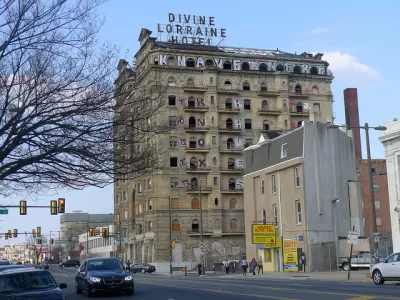
The historic tax credit is threatened in the current version of the House tax bill released last week. Its loss would greatly reduce developers' ability to renovate historic buildings and threaten cities' ability to revitalize older districts, and cities like Philadelphia already have a hard time saving old buildings even with the credit in place.
Architecture critic Inga Saffron of the Philadelphia Inquirer cites numerous historic renovations in Philadelphia that have relied heavily on the historic tax credit in order to pencil out. The Divine Lorraine is just one example. Writes Saffron, the Divine Lorraine:
"would never have been salvaged — never mind restored to its original architectural splendor — without the help of a federal incentive called the Historic Tax Credit. A tax write-off for people who invest in historic preservation, it was introduced in 1984 by President Ronald Reagan, who saw it as an economically sensible way to make America’s cities and towns beautiful again."
Saffron goes on to produce several other great examples of historic redevelopments across Philadelphia that have saved precious urban resources, spurred other revitalization, and are simply beautiful. As well, she notes National Trust research indicates more than 40,000 buildings have been restored nationwide, creating two million jobs. That alone is reason to save the historic tax credit.
FULL STORY: GOP Tax Plan Would Kill Federal Program that Drove Philadelphia's Revival

Philadelphia Could Hit the Brakes on Housing
With bills on the table to update its zoning code, Philadelphia may be poised to slow the pace of its housing construction.
Philadelphia's Housing Incentives Shoot School Funding in the Foot
Philadelphia Inquirer Architecture Critic Inga Saffron is the latest to respond to an article in the Washington Post asking whether family-friendly cities make economic sense.
Why America Need Architecture Critics like Philadelphia's Inga Saffron
The writing of Inga Saffron "makes an ardent plea for more critics willing to take up the mantle of urban citizenship," according to a recent article in The Architectural Review.

Planetizen Federal Action Tracker
A weekly monitor of how Trump’s orders and actions are impacting planners and planning in America.

The state-sanctioned urbicide of Austin
People don’t kill cities. Freeways do.

US to reduce Colorado River water deliveries to Mexico
A new Colorado Treaty amendment reduces Mexico’s Colorado River water allocation by 250,000 acre feet.

5 New England states march closer to 800 megawatt wind energy project
Securing federal approval for the project may be complicated under the Trump administration, which has historically been hostile towards domestic wind power.

Baltimore to break ground on $50 million Transit Priority Project
The project will bring faster bus trips, safer streets and better bike connections to Baltimore.

Airbnb launches $250 million 'last-dollar financing' housing accelerator, makes first investment in Austin
The company will put $6.4 million towards affordable housing development in Texas’ capital.

FREE Course: Walkable City 1: Why Walkability?
After describing his path towards focusing on walkability as the essence of good planning, Jeff Speck marches through his five principal reasons for making more walkable places.
Reinventing Malls: Planning Alchemy—Turning Gray Fields Into Gold
The course focuses on the opportunities and imperatives that shape reinvention of mall sites.

Eagle County Government
Harvard University Graduate School of Design
Nashville Planning Department
The Architects Foundation
University of Cincinnati Online
The Pocatello Development Authority
The Urban Renewal Agency of the City of Pocatello
Journal of the American Planning Association