Planning scholar Bill Fulton, longtime resident of L.A. and relatively recent transplant to Houston, sizes up the urban implications of a World Series played between two very similar cities.


"When I moved to Houston three years ago – after living in Southern California for thirty years – the thing that struck me more than anything was how similar its urban form is to Los Angeles. An enormous, low-rise city laid out on a grid across a gigantic coastal plane. Glued together by a highly developed freeway system. Punctuated by large job centers scattered across the landscape. Slowly realizing that maybe cars aren’t the answer to everything. And gradually rediscovering the underlying natural environment that gave rise to the city in the first place."
"As I learn more about this moment in Houston’s history, I am struck by the similarities with the Los Angeles I lived in during the late ‘80s and early ‘90s. The emerging world-class traffic problems. (The 610 Loop around The Galleria reminds me so much of the 405 on the Westside.) The dependence on traditional industries that may not be around forever. The struggles of a black-white city accommodating a wide range of emerging ethnicities, especially a fast-growing Hispanic population. The unaffordable housing. The gradual coming to terms with the idea that a world-class city must be urban, not suburban, in nature."
FULL STORY: The World Series of Sun Belt Cities

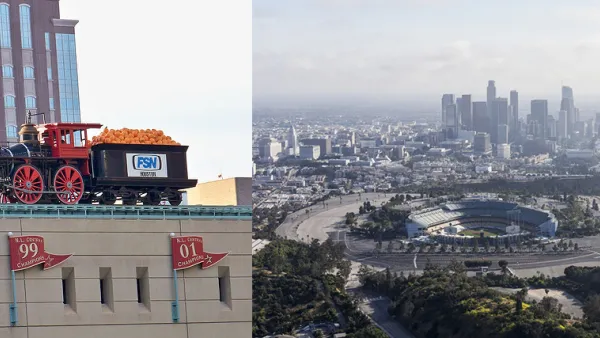
The World Series of Housing Markets
Comparing the housing markets of Houston and Los Angeles—two of the nation's metropolitan area's most commonly associated with auto-centric sprawl—before their respective Major League Baseball teams square off in the 2017 World Series.
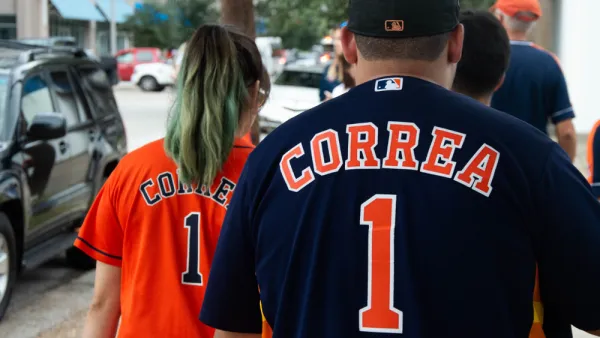
Friday Funny: Zoning Provides Nationals Fans With Another Bragging Point Over Astros Fans
The worlds of baseball and zoning collide again.
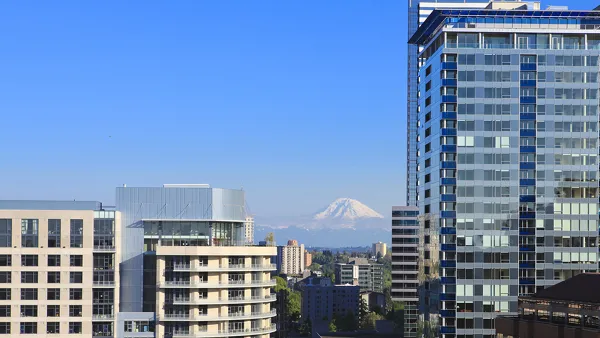
2020 Population Growth Rates for the 50 Biggest U.S. Cities
The Census Bureau released new data on May 27 that includes the first four months of the pandemic. Seattle tops the growth rate at 2.2% from July 1, 2019, to July 1, 2020, while Baltimore and San Francisco land at the bottom with -1.4%.

Planetizen Federal Action Tracker
A weekly monitor of how Trump’s orders and actions are impacting planners and planning in America.

The state-sanctioned urbicide of Austin
People don’t kill cities. Freeways do.

US to reduce Colorado River water deliveries to Mexico
A new Colorado Treaty amendment reduces Mexico’s Colorado River water allocation by 250,000 acre feet.

5 New England states march closer to 800 megawatt wind energy project
Securing federal approval for the project may be complicated under the Trump administration, which has historically been hostile towards domestic wind power.

Baltimore to break ground on $50 million Transit Priority Project
The project will bring faster bus trips, safer streets and better bike connections to Baltimore.

Airbnb launches $250 million 'last-dollar financing' housing accelerator, makes first investment in Austin
The company will put $6.4 million towards affordable housing development in Texas’ capital.

FREE Course: Walkable City 1: Why Walkability?
After describing his path towards focusing on walkability as the essence of good planning, Jeff Speck marches through his five principal reasons for making more walkable places.
Reinventing Malls: Planning Alchemy—Turning Gray Fields Into Gold
The course focuses on the opportunities and imperatives that shape reinvention of mall sites.

Eagle County Government
Harvard University Graduate School of Design
Nashville Planning Department
The Architects Foundation
University of Cincinnati Online
The Pocatello Development Authority
The Urban Renewal Agency of the City of Pocatello
Journal of the American Planning Association