While mayors of shrinking cities do all they can to buoy a discouraging metric, others ask whether population growth is all it's cracked up to be.


It makes sense to see leaders like Detroit mayor Mike Duggan focus heavily on population growth. As J.B. Wogan writes, "Population loss can become a symbol for other things people feel is going wrong in a city, such as rising poverty and unemployment rates, vacant and blighted housing, increased violent crime, the exit of pro sports franchises, racial segregation and police brutality."
People vote with their feet, so the story goes, and rising populations imply basic desirability. Wogan goes on, "Interestingly, it's the mayors of cities struggling to attract people who insist population numbers are the secret of success. The mayors of the fastest-growing cities tend to have a much different attitude about population gains."
The creed of growth-at-all-costs has its challengers. "Perhaps the leading voice in this contrarian club is Paul Gottlieb, an economist at Rutgers University. He has argued for decades not only that local elected officials should take a measured approach to growth, but that metropolitan areas with stable or slow-growing populations are likely to have greater economic prosperity." Wogan discusses similar views from Eben Fodor and Charles Marohn.
While residents of growing cities may not be automatically better off, interest groups like retailers, the real estate industry, and developers are often at hand to sing growth's praises. At the same time, analysis treating cities as separate entities from surrounding communities can oversimplify.
Read the full story: Population Growth Means a City Is Thriving, or Does It?

Where Population Declines but the Economy Grows
While the scale of Detroit's population loss is well known, the lesser known that the city's economy has grown steadily in recent decades. It's not alone.

Learning loss and urban schools, part 2
Did test scores in progressive cities drop more post-COVID than test scores in moderate ones?
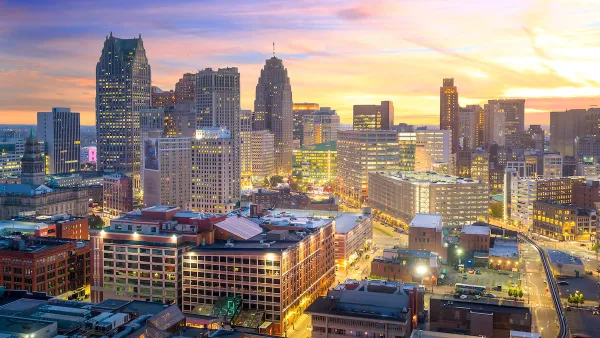
Detroit and Michigan on the Upswing
It's been 66 years since the Motor City last grew its population. Census data released last month revealed an increase of nearly 2,000 people last year, nearly half the state's population growth.

Planetizen Federal Action Tracker
A weekly monitor of how Trump’s orders and actions are impacting planners and planning in America.

California plans to bury El Niño’s downpour
If the state plays its cards right, it may be able to store a billion acre-feet of El Niño’s water in aquifers.

Desperate measures: Advocates weigh draining Lake Powell to fill Colorado River
Draining the reservoir could reduce evaporation losses by a couple hundred thousand acre-feet.

US buildings threatened, destroyed by fires set to triple by 2060
Researchers found a high fire risk for socioeconomically vulnerable neighborhoods in the American West.

LA residents may be allowed to paint their own crosswalks
Councilwoman Katy Yaroslavsky put out a motion instructing the Los Angeles Department of Public Transportation to study the feasibility of allowing volunteers to paint crosswalks.

Dallas moves to overhaul its zoning code
The city's zoning reform will allow more multi-family and mixed-use developments.

FREE Course: Walkable City 1: Why Walkability?
After describing his path towards focusing on walkability as the essence of good planning, Jeff Speck marches through his five principal reasons for making more walkable places.
Reinventing Malls: Planning Alchemy—Turning Gray Fields Into Gold
The course focuses on the opportunities and imperatives that shape reinvention of mall sites.

City of Rosemead
Rutgers University, Edward J. Bloustein School of Planning and Public Policy
One Hundred Miles
Hunter College, City University of New York (CUNY)
The Architects Foundation
University of Cincinnati Online
City of Cambridge
Montrose County
The Pocatello Development Authority