In the past, stormwater management has been about flood control. The future of stormwater, however, is in capturing, treating, and recharging water supply, according to this article.


Chris Austin, otherwise known as the Maven of California water news, shares a presentation from Dr. Richard Luthy, a professor of civil and environmental engineering and the director of the National Science Foundation’s Engineering Research Center, describing the evolution of stormwater infrastructure.
According to Luthy, a shift away from stormwater management as flood control would bring multiple benefits. Not only would urban areas like Los Angeles gain critical water supply for a growing population, "it would provide other community benefits, like cleaning the beaches."
Luthy is building on existing plans by the city of Los Angeles to cut the amount of water supply it imports by half:
How is that achieved? One of the solutions is stormwater capture, and on this drawing, it says the stormwater would be 4% of the urban water supply, and in a moment I’ll show you that it could really be much more than that. It could be 3, 4, maybe even 5 times that if plans come into being in this century.”
In addition to an appeal to use bigger systems to achieve more ambitious goals, Luthy also shows how stormwater capture infrastructure can become open space and recreation facilities during dry seasons (e.g., hiking trails, basketball courts, and playfields). Finally, Luthy detailed the processes that would be necessary to treat stormwater runoff that could potentially be contaminated with pathogens, organics, and nitrates.
Renderings, schematics, and other infographics drawn directly from Luthy's presentation supplement the article.
Read the full story: Stormwater capture, treatment and recharge for urban water supply

Los Angeles Wants its River Back From the Feds
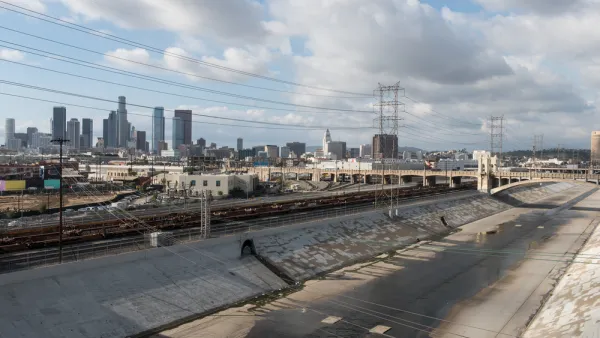
Regional officials don't think the federal government is doing enough to warrant continued ownership of the Los Angeles River flood control channels that cut a 40-mile path through the city and county.
California's Stormwater Potential
A new study reveals that if California could collect and treat more stormwater in cities, it could provide enough water to supply a quarter of the state’s urban population.
LA’s ‘Spongy’ Infrastructure Captured Almost 9 Billion Gallons of Water
The city is turning away from stormwater management practices that shuttle water to the ocean, building infrastructure that collects and directs it underground instead.

Planetizen Federal Action Tracker
A weekly monitor of how Trump’s orders and actions are impacting planners and planning in America.

Amtrak, CN end decades-long dispute with eight-year agreement
The new operating agreement establishes an updated framework for the companies to work together, including processes to resolve disputes.

Northwest rail fans eager for Sept. 30 debut of Amtrak’s Airo fleet
Get ready for that new train smell and more seats. But they won’t go faster or run more frequently on the Cascades route in Washington and Oregon.

Brightline Florida files for bankruptcy
The transit company is over $5 billion in debt.

St. Louis Metro to test if single-car trains can reduce operating costs, maintain rider satisfaction
The pilot program will run from October to spring 2027, and begin with one single-car train operating on Metrolink’s Red and Blue lines.

Pennsylvania is building data centers in abandoned mines
Housing data centers in mines provides an alternative to destroying local forests and may spare residents from data centers’ noise and air pollution.

FREE Course: Walkable City 1: Why Walkability?
After describing his path towards focusing on walkability as the essence of good planning, Jeff Speck marches through his five principal reasons for making more walkable places.
Reinventing Malls: Planning Alchemy—Turning Gray Fields Into Gold
The course focuses on the opportunities and imperatives that shape reinvention of mall sites.

City of Thousand Oaks
City of Wisconsin Rapids
Harvard University Graduate School of Design
The Architects Foundation
University of Cincinnati Online
The Pocatello Development Authority
The Urban Renewal Agency of the City of Pocatello