One hot button item to watch as Congress takes up the issue of tax reform in the coming weeks: whether Republicans are able to follow through on a promise to reform the mortgage interest deduction.


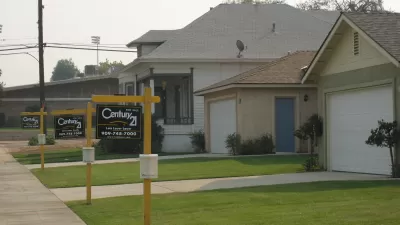
Diana Olick writes: "The mortgage interest tax deduction has long been considered politically untouchable — until now, that is."
According to Olick, the forthcoming Congressional debate about tax reform is still expected to take up the matter of the mortgage interest deduction.
The mortgage interest deduction, which only benefits about 20 percent of taxpayers, is currently capped at loans up to $1 million for married couples who file jointly and at $500,000 for individual filers. The median value of a U.S. home just crossed the $200,000 market, according to Zillow, so not a lot of people make it to that cap.
Olick's sources say that early discussions are pushing the target for the cap toward $600,000, though Senate Majority Leader Mitch McConnell is on the record recently saying people worried about the deduction can "breathe easy."
For more on the influence of the mortgage interest deduction to the built environment as well as the nation's economy, see previous Planetizen coverage.
Read the full story: Popular mortgage deduction could get a haircut in tax reform

Trump's Tax Reform Proposal Would Have a Big Effect in the Housing Market
Housing prices may fall 10 percent on average nationwide, according to a preliminary estimate commissioned by the National Association of Realtors, if the Trump Administration's tac code reform package becomes law.

Tax Reform and the Housing Market
Curbed analysis of how local and regional housing markets will react to changes to the country's tax code.

Home Ownership Subsidy Takes a $250,000 Hit in Final Version of Tax Bill
The current mortgage interest deduction is $1 million. The House version of the tax bill called for a $500,000 cap while the Senate left it untouched. They split the difference and capped it at $750,000. Congress is expected to pass H.R. 1 this week

Planetizen Federal Action Tracker
A weekly monitor of how Trump’s orders and actions are impacting planners and planning in America.

Eastern Nebraska is running out of electricity
Data centers and electrification are straining eastern Nebraska’s grid, throttling economic development.

Study reveals best places in the U.S. for cycling, walking
New research from Streetlight Data examines bicycle and pedestrian miles per capita in the 100 largest U.S. cities by population.

DSA members accuse Mamdani of 'abandoning values' over housing redevelopment
New York City's mayor plans to replace about 2,000 units of public housing with private, mixed-income housing.

All sides of BRT debate unhappy with CDOT’s most recent move
The Colorado Department of Transportation is no longer considering center-running bus lanes for Colorado Boulevard.

Massachusetts bogs generate both power, and cranberries
Putting solar panels above farmland is one way Massachusetts is advancing toward its goal of net-zero carbon emissions by 2050.

FREE Course: Walkable City 1: Why Walkability?
After describing his path towards focusing on walkability as the essence of good planning, Jeff Speck marches through his five principal reasons for making more walkable places.
Reinventing Malls: Planning Alchemy—Turning Gray Fields Into Gold
The course focuses on the opportunities and imperatives that shape reinvention of mall sites.

City of Rosemead
Rutgers University, Edward J. Bloustein School of Planning and Public Policy
One Hundred Miles
University of Michigan School for Environment and Sustainability (SEAS)
Hunter College, City University of New York (CUNY)
The Architects Foundation
City of Cambridge
The Pocatello Development Authority
The Urban Renewal Agency of the City of Pocatello