The city of Houston and Texas Central Partners signed an MOU this week that details how some of the work on the high-speed rail project will proceed.


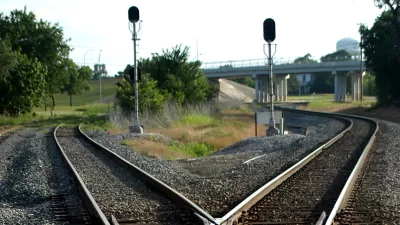
"Backers of a Texas high-speed rail line on Thursday announced for the second time this week what they called significant progress on the controversial line, inking an agreement with Houston officials, detailing the work to come," reports Dug Begley.
Houston and Texas Central Partners entered a memorandum of understanding, "which commits both sides to share environmental surveys, utility analysis and engineering related to the project and surrounding area and work together to develop new transit and other travel options to and from the likely terminus of the bullet train line."
The article includes a lot more detail on the plan for the line around the city of Houston, and reiterates the nature of the project's public-private partnership. As Begley hinted in the first quote above, Texas Central Partners also announced this week the selection of Irving-based Fluor Enterprises and The Lane Construction Corporation, based in Connecticut, for planning and engineering work on the project. Begley reported on that announcement in an earlier article, also including reasons for concern about the viability of the project having mostly do to with Texas Central Partners' lack of eminent domain authority.
Read the full story: Houston backs bullet train, inks deal to help progress

Texans Against High-Speed Rail Begin to Flex Legal Muscle
Opposition to the Dallas-to-Houston private Texas Central high-speed rail line has gotten more serious with the creation of a defense fund to assist property owners in protecting their property rights. Texas Central plans to break ground next year.
Texas, California Rail Projects Seek Out Private Funding
In the wake of Trump’s cuts to high-speed rail projects, rail authorities are looking to private-public partnerships to supplement their budgets.

Will Texas High-Speed Rail Become a Reality?
A proposed Houston-to-Dallas rail line shows promise, but faces major hurdles before it can come to fruition.

Planetizen Federal Action Tracker
A weekly monitor of how Trump’s orders and actions are impacting planners and planning in America.

Washington state to charge fee to drivers with fuel-efficient cars
Revenue from the fee will go towards supporting the state’s highways.

Illinois considers spending $1 billion in taxpayer money on data center
A quantum computing campus and data center are currently under construction in Chicago.

Amtrak invests in eight new Airo trainsets
The new trainsets will begin serving passengers in 2031.

HUD to end aid for mixed-immigration-status households
The new rule is projected to impact 80,000 people, nearly half of whom are children.

Trump has changed his mind on congestion pricing — maybe
The Trump administration is offering $100 million in grants so cities can implement their own traffic control programs.

FREE Course: Walkable City 1: Why Walkability?
After describing his path towards focusing on walkability as the essence of good planning, Jeff Speck marches through his five principal reasons for making more walkable places.
Reinventing Malls: Planning Alchemy—Turning Gray Fields Into Gold
The course focuses on the opportunities and imperatives that shape reinvention of mall sites.

City of Charlotte
City of Rosemead
Rutgers University, Edward J. Bloustein School of Planning and Public Policy
University of Michigan School for Environment and Sustainability (SEAS)
Hunter College, City University of New York (CUNY)
The Architects Foundation
University District Partnership