The Guardian shares news of a new study of a Jakarta lane that could prove that carpool requirements work to reduce driving and congestion.



Josh Cohen reports on a study that evaluated the outcomes of Jakarta's "three-in-one" high occupancy vehicle (HOV) lane policy, implemented between 2003 and 2016. The law requires "private vehicles to carry three people to drive on the main roads in Jakarta’s central business district, from 7-10am and 4.30-7pm," explains Cohen.
"Many believed the policy was ineffective and felt that opening the restricted road to all would help traffic flow better, but a new study published in the journal Science found the opposite to be true," writes Cohen. "Hanna and MIT researchers Gabriel Kreindler and Benjamin A Olken discovered traffic congestion worsened after Jakarta lawmakers abruptly eliminated the HOV policy in April 2016."
Though controversy surrounded "'jockeys' who would stand just outside the enforcement area and offer to join a single-occupancy vehicle for a fee so the driver could enter the three-in-one zone," while the law was in place, the study found that there were enough people staying out of their cars to outweigh the number of scofflaws skirting the rules. Once all of those people stopped driving in carpools, "the newly unrestricted main roads were unable to accommodate the increase in vehicles from people no longer car-pooling."
Read the full story: Lessons from the fast lane: does this study prove car-pooling works?

Jakarta Confronts its Transit Transgression
You think your daily commute is bad? In one of the world's largest cities, a lack of citywide rapid transit means daily commutes of four hours for many Jakarta residents. Help is on the way, but conditions may get worse before they get better.
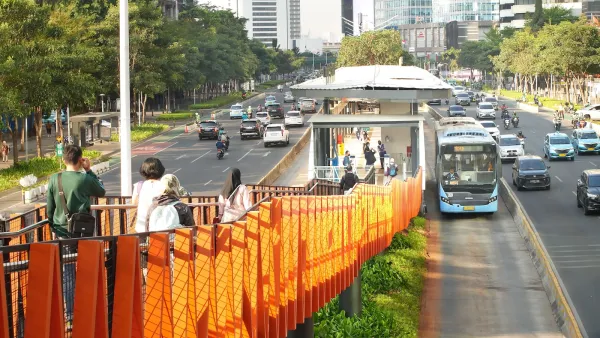
How Jakarta built the world's largest BRT system
Once known for total gridlock, the Indonesian capital has transformed itself into a public transit leader.
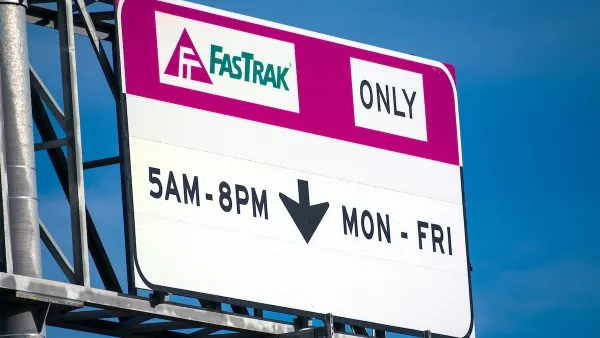
Report: Traffic Slower Near Bay Area Express Lanes
Highway 101 was expanded to add express lanes with the promise of reducing congestion for all of the roadway’s users.

Planetizen Federal Action Tracker
A weekly monitor of how Trump’s orders and actions are impacting planners and planning in America.

Amtrak, CN end decades-long dispute with eight-year agreement
The new operating agreement establishes an updated framework for the companies to work together, including processes to resolve disputes.

Colorado’s Largest Data Center Could Rise Next to Homes — Without a Public Hearing
The proposed campus would consume 11 times the power of Denver International Airport; as it has across the country, opposition mounts.

'This is going to be painful:’ Virginia stares down $1.7 billion funding gap for highway maintenance
The state may address the deficit by shifting $290 million from its construction budget to maintenance projects.

Judges permit Denver to divert 77,000 acre feet from the Colorado River for reservoir expansion
Overuse and climate change have caused the Colorado River’s water levels to plummet.

Amtrak, CN end decades-long dispute with eight-year agreement
The new operating agreement establishes an updated framework for the companies to work together, including processes to resolve disputes.

FREE Course: Walkable City 1: Why Walkability?
After describing his path towards focusing on walkability as the essence of good planning, Jeff Speck marches through his five principal reasons for making more walkable places.
Reinventing Malls: Planning Alchemy—Turning Gray Fields Into Gold
The course focuses on the opportunities and imperatives that shape reinvention of mall sites.

KFH Group Inc.
Greater Baltimore Committee
Eagle County Government
The Architects Foundation
University of Cincinnati Online
The Pocatello Development Authority
The Urban Renewal Agency of the City of Pocatello