Changing enforcement and greater activation have changed Commons Park in Denver, which is no longer the site of the drug use that gave the hill its moniker.



The homeless population that used to spend its time on the hill in Commons Park in Denver has been moved. "Denver Parks and Recreation officials and Cohen’s Riverfront Park Association tried out different strategies to nudge along homeless adults and the young people, including a heavy mix of pot smokers and other drug users, who sat on the hill and surrounding areas for much of the day," John Murray reports for the Denver Post.
After city park officials installed nine security cameras and hired private security, the site became less attractive to the homeless who spent days there. Many in the neighborhood say they can see a big difference. Park officials also claim their efforts to activate the park with events helped change the population that’s using the public space.
Read the full story: Commons Park’s “Stoner Hill” no longer fits the name, and Denver riverfront residents hail the change


Denver Canal Trail to Receive $100 Million Upgrade
The funding will support maintenance and repair projects along the 71-mile High Line Canal.
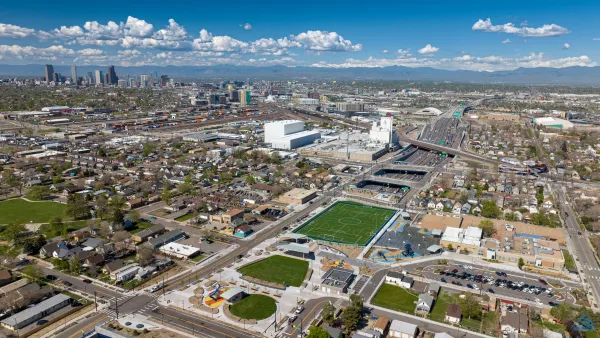
Opening of Denver’s New Freeway Cap Park Triggers Gentrification Fears
Local residents fear rising housing costs and displacement with the opening of a new four-acre park built on a deck bridge over the newly reconstructed and widened I-70 interstate.

Denver Residents Lack Transit Access to Local Parks
Despite an early plan to run rail lines to the city’s mountain parks, they are not easily accessible to Denverites without cars.

Planetizen Federal Action Tracker
A weekly monitor of how Trump’s orders and actions are impacting planners and planning in America.

California plans to bury El Niño’s downpour
If the state plays its cards right, it may be able to store a billion acre-feet of El Niño’s water in aquifers.

Chicago breaks ground on $3 billion megadevelopment
The new neighborhood, titled Foundry Park, will one day host 3,700 residences.

California High-Speed Rail Authority CEO resigns after $600,000 scandal
Under Ian Choudri, the authority used taxpayer dollars to fund first class flights and trips to nightclubs.

Want to study the Missouri River? Soon, you may need unanimous approval from 10 states
Legislation would require 10 governors’ permission to study or build projects moving water outside the basin.

Desperate measures: Advocates weigh draining Lake Powell to fill Colorado River
Draining the reservoir could reduce evaporation losses by a couple hundred thousand acre-feet.

FREE Course: Walkable City 1: Why Walkability?
After describing his path towards focusing on walkability as the essence of good planning, Jeff Speck marches through his five principal reasons for making more walkable places.
Reinventing Malls: Planning Alchemy—Turning Gray Fields Into Gold
The course focuses on the opportunities and imperatives that shape reinvention of mall sites.

City of Rosemead
Rutgers University, Edward J. Bloustein School of Planning and Public Policy
One Hundred Miles
Hunter College, City University of New York (CUNY)
The Architects Foundation
University of Cincinnati Online
City of Cambridge
Montrose County
The Pocatello Development Authority