A forthcoming opportunity for Houston offers a chance to consider the ingredients for a successful innovation district, and what level of intervention, public and private, is required to make the concept succeed.



"Two [Houston] task forces, one put together by city government, the other by the business community, recommended that the city designated a tech district, which could increase property values in the chosen neighborhood and boost the standing of politicians who help secure that designation," reports Lydia DePillis.
DePillis explains the rationale behind innovation districts, as promoted by think tanks like the Brookings Institution and civic boosters like Tony Hsieh of Zappos and Las Vegas fame, before digging into the "jockeying" for position in the race to locate Houston's new innovation district. Among the neighborhoods with advocates in their corner: EaDo, Montrose, and Rice Village.
FULL STORY: Where should Houston's innovation district be?

Houston Creating 'Equity Indicators' Report
To better plan and track its progress toward equity, the city of Houston is creating a new system of equity indicators.
Visions of the Future Houston
An ongoing exhibition in Houston imagines a city on the cusp of a new, more prosperous future.
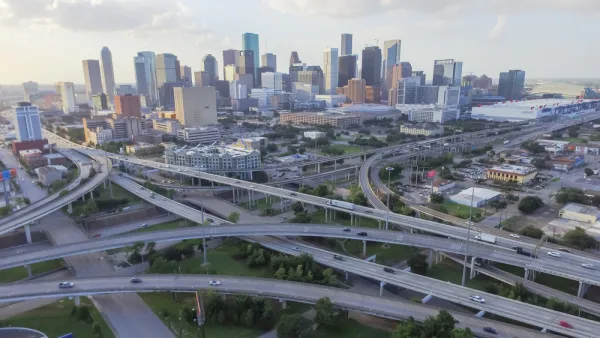
TxDOT Approves I-45 Widening Despite Local Opposition
Despite every manner of local opposition, the Texas Department of Transportation is pushing forward with a plan to widen Interstate 45 north of the city of Houston, demolishing and displacing thousands of homes, businesses, and community facilities.

Planetizen Federal Action Tracker
A weekly monitor of how Trump’s orders and actions are impacting planners and planning in America.

The state-sanctioned urbicide of Austin
People don’t kill cities. Freeways do.

US to reduce Colorado River water deliveries to Mexico
A new Colorado Treaty amendment reduces Mexico’s Colorado River water allocation by 250,000 acre feet.

Mamdani overhauls NYC's Vision Zero plan with 100 new policy goals
The overhaul aims to reduce traffic deaths and make streets safer for pedestrians, cyclists and drivers through lower speed limits, new safety infrastructure and more.

Amtrak not solely to blame for New Jersey commuter rail's unreliability, report finds
A new study from the Garden State Initiative found that NJ Transit’s budget grew 20% across a 4 year period, but reliability declined significantly over the same period.

EPA erases limits on planet-warming pollution from power plants
Under Monday’s plan, power plants would still have some limits on how much mercury, arsenic and other contaminants they can emit.

FREE Course: Walkable City 1: Why Walkability?
After describing his path towards focusing on walkability as the essence of good planning, Jeff Speck marches through his five principal reasons for making more walkable places.
Reinventing Malls: Planning Alchemy—Turning Gray Fields Into Gold
The course focuses on the opportunities and imperatives that shape reinvention of mall sites.

Eagle County Government
Harvard University Graduate School of Design
Nashville Planning Department
The Architects Foundation
University of Cincinnati Online
The Pocatello Development Authority
The Urban Renewal Agency of the City of Pocatello
Journal of the American Planning Association