An ongoing exhibition in Houston imagines a city on the cusp of a new, more prosperous future.


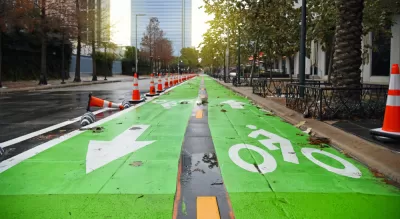
Lisa Gray shares insights from an ongoing exhibition at the new Architecture Center Houston headquarters titled "Houston 2020 Visions."
The exhibition showcases the fruits of a competition inspired by Hurricane Harvey that asked architects to envision the city’s future. The exhibit was delayed due to the COVID-19 pandemic—a still lingering reality that ads additional urgency to the exhibition, according to Gray: "Strangely, the questions at the show’s heart — What’s next? How do we build a better, more resilient city? — have never felt more urgent."
Given that context and the offerings on display in the show, Gray suggest that is the city is about to enter a new phase of its history: "a chance to make this place safer, cleaner, greener, tougher and more fun."
The article, is behind a paywall, features renderings from the show to illustrate the themes identified by Gray. Themes include reconsidering freeways, new kinds of housing, the long-term influence of the pandemic, and repositioning the city relative to the flooding that occurs in the region, among others.
Speaking of resilience and Houston, the Resilient Houston plan recently turned a year old, and the Rice University Kinder Institute for Urban Research surveyed the progress on the landmark plan.
Read the full story: Future Houston: Designs for the city we might become [paywall]
Tracking Resilient Houston's Progress
The Resilient Houston initiative promises to strengthen the city's infrastructure and increase its capacity to thrive and adapt under crisis.
Advocates: Equity Lacking in the New Houston Climate Action Plan
Advocates and local residents are expressing concern about a lack of direct support in the Houston Climate Action Plan for underserved neighborhoods that have already experienced some of the worst effects of climate change.
'Resilient Houston' Plan Released
The 186-page "Resilient Houston" document was released to the public in the nation's fourth largest city, which is facing numerous environmental stresses.

Planetizen Federal Action Tracker
A weekly monitor of how Trump’s orders and actions are impacting planners and planning in America.

Eastern Nebraska is running out of electricity
Data centers and electrification are straining eastern Nebraska’s grid, throttling economic development.

Washington state to charge fee to drivers with fuel-efficient cars
Revenue from the fee will go towards supporting the state’s highways.

Instead of building new housing, LA developers are turning mansions into mega-mansions
In the richest areas, the number of houses valued at $30 million with demolition permits has skyrocketed since 2018.

Illinois considers spending $1 billion in taxpayer money on data center
A quantum computing campus and data center are currently under construction in Chicago.

As development costs rise, Boston moves to lessen affordable housing requirements
The Boston Zoning Commission and the City Council still need to approve Boston Mayor Michelle Wu’s proposed changes

FREE Course: Walkable City 1: Why Walkability?
After describing his path towards focusing on walkability as the essence of good planning, Jeff Speck marches through his five principal reasons for making more walkable places.
Reinventing Malls: Planning Alchemy—Turning Gray Fields Into Gold
The course focuses on the opportunities and imperatives that shape reinvention of mall sites.

City of Charlotte
City of Rosemead
Rutgers University, Edward J. Bloustein School of Planning and Public Policy
University of Michigan School for Environment and Sustainability (SEAS)
Hunter College, City University of New York (CUNY)
The Architects Foundation
City of Cambridge
The Pocatello Development Authority
The Urban Renewal Agency of the City of Pocatello