In a major announcement that could shake-up the auto industry, Volvo Cars declared it will initiate a gradual divorce from autos solely powered by internal combustion in two years. The Chinese-owned company wants to reduce its environmental impact.


"Volvo Cars became the first mainstream automaker to sound the death knell of the internal combustion engine, saying on Wednesday that all the models it introduces from 2019 will be either hybrids or powered solely by batteries," reports Jack Ewing for The New York Times.
The decision is the boldest commitment by any major car company to technologies that currently represent a small share of the total vehicle market, but that are increasingly viewed as essential to combating climate change and urban pollution.
The company emphasized in its press release that the move is in keeping with its environmental commitment:
The announcement underlines Volvo Cars’ commitment to minimising its environmental impact and making the cities of the future cleaner. Volvo Cars is focused on reducing the carbon emissions of both its products as well as its operations. It aims to have climate neutral manufacturing operations by 2025.
Volvo's transition to EV technology will be gradual.
"It plans to still produce existing models with conventional engines after 2019, but it will no longer introduce new models with the older technology. Depending on demand, Volvo will completely phase out cars powered solely by gasoline or diesel by around 2024.
However, not all their models by 2024 will be plug-in electric vehicles (PEVs). Some will be "mild hybrid vehicles," powered by gasoline or diesel, which are less efficient than Prius-type hybrids. "Mild hybrids take some load off an internal-combustion engine by powering accessories or providing an extra boost of power to the wheels, but generally can't propel a car on electricity alone," clarifies Stephen Edelstein for Green Car Reports.
Even so, hybrid vehicles have seen a sales decline in recent years due to cheap gas and many owners transitioning to PEVs, which include plug-in hybrid electric vehicles that can operate on both gas and battery power, accounting "for about 2 percent of passenger car sales in the United States last year," adds Ewing.
Optimistic about future of Electric Vehicles
Still, most carmakers expect the share of electric cars to grow quickly as the technology improves, prices fall and public charging stations become more commonplace. Rapid advances in self-driving cars will also encourage a shift to battery power: It is simpler to link self-driving software to an electric motor than to a conventional engine.
Influence of China's commitment to environment
While still based in Sweden, Volvo Cars was acquired by Geely Holding Group, a Chinese multinational automotive manufacturing company, in 2010, "and has been a totally separate company from the Swedish industrial conglomerate AB Volvo since 1999," according to Wikipedia. Geely already produces EVs for China, the world's largest EV market.
While the Trump Administration's commitment to roll back environmental regulations is not helpful for the future of EVs in the United States, the Chinese government under President Xi Jinping has embraced the Paris climate agreement and reducing urban air pollution while Trump announced on June 1 that the United States would withdraw from the historic accord to stabilize the world's climate by reducing greenhouse gas emissions.
Analysts said Volvo’s decision to pursue a lineup dedicated to electric and hybrid vehicles is motivated, in part, by the Chinese government’s efforts to reduce harmful emissions from internal combustion engines.
"Chinese ownership of Swedish-based Volvo likely played a role in the automaker’s announcement today," said Michelle Krebs, an analyst with the auto-research site Autotrader.com. "China’s air pollution problems have prompted a more serious push toward cleaner automobiles."
Global auto companies will be watching Volvo to see how the move pans out. In the United States, where SUVs and other light trucks composed a record 61 percent of motor vehicle sales last year, it may take a major increase in oil prices to make Americans embrace non-oil powered vehicles.
Tesla arrival
In a related development, Neal E. Boudette reports for The Times that Tesla's long-awaited midpriced Model 3 will be rolling off assembly lines "on Friday, two weeks earlier than planned, with the first deliveries on July 28." The range is 215 miles, which is almost as good as the Chevy Bolt's range of 238 miles. Both models cost about $35,000 before a federal tax credit of $7,500 plus state rebates where applicable.
Read the full story: Volvo, Betting on Electric, Moves to Phase Out Conventional Engines


Another Nail in the Coffin of the Internal Combustion Engine?
Is the movement away from gasoline and diesel-powered cars unstoppable? In response to air pollution litigation, the British government announced on July 26 that sales of gasoline and diesel vehicles would be banned by 2040.
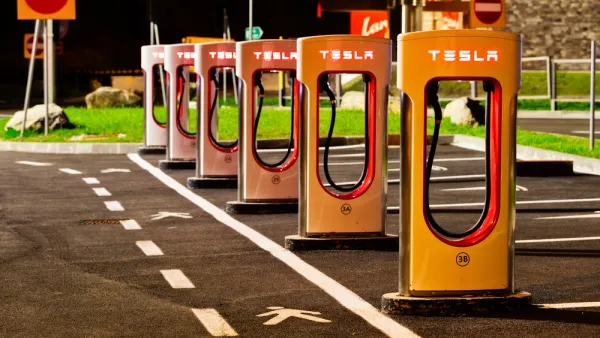
The Era of the Electric Vehicle is Approaching
A new report from Bloomberg New Energy Finance predicts that due to a plunge in battery prices and improvement in battery technology, electric vehicles will be cost-competitive with gasoline vehicles in eight years. By 2040, they will outsell them.
California Climate Program Offers Up to $9,500 Toward Purchase of Used EVs
Lawmakers want to ensure that electric vehicles are accessible to all Californians, particularly lower-income motorists in disadvantaged communities. Unlike other incentive programs, participants must also scrap an older, polluting vehicle.

‘Going backwards:’ Baltimore mayor, students rally against state's transit funding plan
Maryland's proposed six-year plan provides no funding for Baltimore’s BMORE bus program and reduces its road maintenance funding.

Detroit to transform waterfront with $2.2 billion investment
Developers will convert about 18 acres of unused parking lot space into civic spaces.

Mamdani sent nearly 6,000 pied-à-terre tax warnings to homes that didn’t qualify
A judge has ordered the administration to cancel thousands of pied-à-terre tax notices after it sent 35% of them erroneously.

25 states, cities sue the EPA over erased power plant emissions limits
The coalition also intends to sue the EPA for not regulating emissions from gas-fired power plants.

Newsom vetoes giving CA tribes greater voice in water projects
In his veto letter, Newsom said the bill would add ‘uncertainty’ to the state’s fight to secure Californians’ water supplies.

Michigan Senate votes to revise 'lax' dam safety laws
A Bridge Michigan investigation found more than 100,000 Michigan residents live in the floodpath of a high or significant-hazard dam.

FREE Course: Walkable City 1: Why Walkability?
After describing his path towards focusing on walkability as the essence of good planning, Jeff Speck marches through his five principal reasons for making more walkable places.
Reinventing Malls: Planning Alchemy—Turning Gray Fields Into Gold
The course focuses on the opportunities and imperatives that shape reinvention of mall sites.

City of Thousand Oaks
City of Wisconsin Rapids
Harvard University Graduate School of Design
The Architects Foundation
University of Cincinnati Online
Northern Illinois Transit Authority (NITA)
The Pocatello Development Authority
The Urban Renewal Agency of the City of Pocatello