A Manhattan timelapse video shows a startling contrast between bikeshare and car parking when it comes to efficient use of city space.


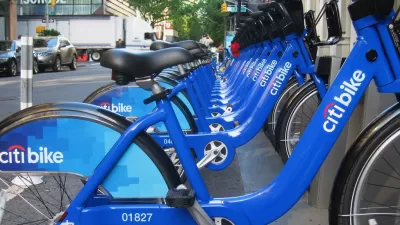
It's no secret that bikes take up less room than cars. But this video shows that in a dense urban environment, dedicating space to parking seems like a terrible, unproductive waste.
John Metcalfe reports: "Luke Ohlson recently recorded the mad rush in time lapse at 5 p.m. on a weekday to make a point about transit in New York. 'Parking takes up 150,000 acres of New York City street space, yet a majority of New Yorkers do not drive or use cars,' says Ohlson, a senior organizer at Transportation Alternatives."
Olson apparently chose the spot exactly for this contrast. "The videographer chose to shoot at Broadway and East 22nd Street because of the block's vastly disparate usages of similarly sized public spaces." We also get a picturesque view of the Empire State Building in the background.
According to Ohlson, "Citi Bike is about a 42-times more productive use of space than car parking."
Read the full story: A Stark Comparison of Parking Vs. Bike-Share Spaces
NYC Launches ‘Smart Curbs’ Program
The pilot program on the Upper West Side will remove some curbside parking spots to replace them with public seating, bike racks, and delivery zones.
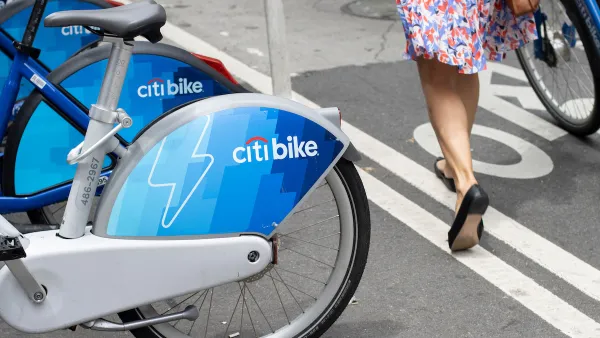
Keeping NYC’s E-Bike Fleet Charged and Running
How a crew of hundreds maintains one of the world’s largest bike share systems.
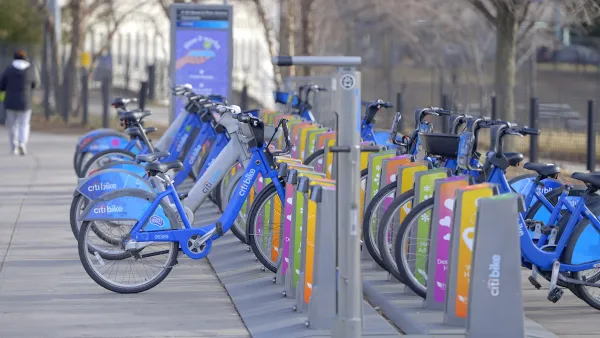
Citi Bike’s New Prices Take Effect
The system plans to expand to 40,000 bikes and 2,000 stations.

Planetizen Federal Action Tracker
A weekly monitor of how Trump’s orders and actions are impacting planners and planning in America.

California plans to bury El Niño’s downpour
If the state plays its cards right, it may be able to store a billion acre-feet of El Niño’s water in aquifers.

Desperate measures: Advocates weigh draining Lake Powell to fill Colorado River
Draining the reservoir could reduce evaporation losses by a couple hundred thousand acre-feet.

Mamdani’s pied-à-terre tax survives legal challenge
A panel of judges found that the plaintiffs failed to demonstrate injury as a result of New York City's implementation of the tax.

Eastern Nebraska is running out of electricity
Data centers and electrification are straining eastern Nebraska’s grid, throttling economic development.

Seattle passes record-breaking transit services expansion
Proposition 1 will double the city’s transit tax to add 95,000 more bus trips and preserve 180,000 bus trips annually.

FREE Course: Walkable City 1: Why Walkability?
After describing his path towards focusing on walkability as the essence of good planning, Jeff Speck marches through his five principal reasons for making more walkable places.
Reinventing Malls: Planning Alchemy—Turning Gray Fields Into Gold
The course focuses on the opportunities and imperatives that shape reinvention of mall sites.

City of Rosemead
Rutgers University, Edward J. Bloustein School of Planning and Public Policy
One Hundred Miles
University of Michigan School for Environment and Sustainability (SEAS)
Hunter College, City University of New York (CUNY)
The Architects Foundation
City of Cambridge
Montrose County
The Pocatello Development Authority