The Sightline Institute thoroughly investigates the use of carbon pricing as a deterrent to greenhouse gas emissions around the world.



Despite the departure of the United States from the Paris Climate Accord, "the rest of the world is moving ahead with carbon pricing programs that will give other countries a head start in the race to a clean energy economy," according to an article by Kristin Eberhard.
Eberhard is sharing an updated map of the world showing carbon pricing policies around the world. "Notably, The United States’ neighbors to the north and south are adopting national carbon pricing programs in 2018, and the European Union and China are allying to become global leaders in the transition to a low-carbon economy."
In all, 40 countries and 24 sub-national regions "have already or are scheduled to soon make polluters pay with a national or regional price on carbon," reports Eberhard. The article includes analysis of how the Paris Climate Accord opened the door for carbon pricing around the world. Moreover, carbon dividends are gaining traction as a policy tool in North America.
Read the full story: MAP: THE FUTURE IS CARBON-PRICED AND THE US IS GETTING LEFT BEHIND


Mexico to Pilot Carbon Pricing
The year-long program will begin in November, laying a foundation for a national carbon market.

Royal Dutch Shell: Big Oil with a Conscience?
Big Oil companies are not all alike. Royal Dutch Shell is the first one to part ways with a major oil industry trade group over differences on climate change. It's also linking executive pay to goals to reduce the company's carbon footprint.
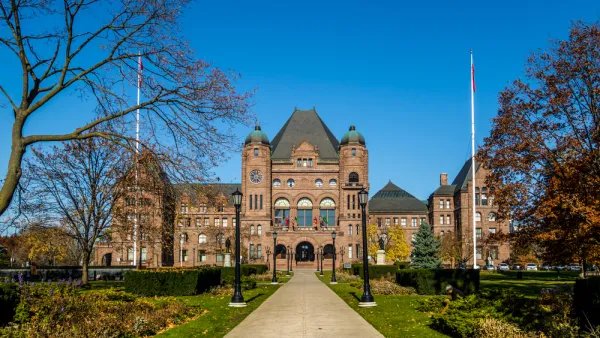
Doug Ford, Elected Ontario Premier, Promises End of Cap and Trade
The brother of former Toronto Mayor Rob Ford decisively won the election on June 7 to be the next premier of Ontario, ousting current Premier Kathleen Wynne. His first order of business: end the province's emissions trading program.

Planetizen Federal Action Tracker
A weekly monitor of how Trump’s orders and actions are impacting planners and planning in America.

Amtrak, CN end decades-long dispute with eight-year agreement
The new operating agreement establishes an updated framework for the companies to work together, including processes to resolve disputes.

Northwest rail fans eager for Sept. 30 debut of Amtrak’s Airo fleet
Get ready for that new train smell and more seats. But they won’t go faster or run more frequently on the Cascades route in Washington and Oregon.

Brightline Florida files for bankruptcy
The transit company is over $5 billion in debt.

St. Louis Metro to test if single-car trains can reduce operating costs, maintain rider satisfaction
The pilot program will run from October to spring 2027, and begin with one single-car train operating on Metrolink’s Red and Blue lines.

Pennsylvania is building data centers in abandoned mines
Housing data centers in mines provides an alternative to destroying local forests and may spare residents from data centers’ noise and air pollution.

FREE Course: Walkable City 1: Why Walkability?
After describing his path towards focusing on walkability as the essence of good planning, Jeff Speck marches through his five principal reasons for making more walkable places.
Reinventing Malls: Planning Alchemy—Turning Gray Fields Into Gold
The course focuses on the opportunities and imperatives that shape reinvention of mall sites.

City of Thousand Oaks
City of Wisconsin Rapids
Harvard University Graduate School of Design
The Architects Foundation
University of Cincinnati Online
The Pocatello Development Authority
The Urban Renewal Agency of the City of Pocatello