Apple employees began moving into the company's new headquarters in Cupertino, California in April. The moving process culminates a development process that launched in 2008 under the helm of Steve Jobs.


"Late last month, Apple’s 12,000 employee workforce began to move into the technology company’s new 2.8-million-square-foot headquarters in Cupertino, California designed by architects Foster + Partners, according to a press release," according to an article by Antonio Pacheco.
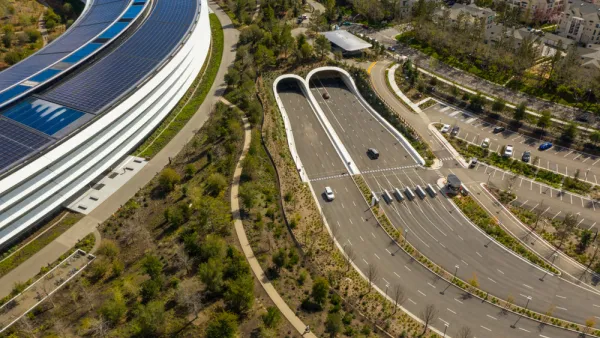
With the move-ins come the first images released by the headquarter's designers, Foster + Partners. The images are the first glimpses of the finished building, with, according to Pacheco, "contains the largest operable glass walls in the world, among its other superlative qualities."
Here's more from Pacheco on the design and layout of the building:
The main, four-story building is topped by slightly-gabled roof containing an 805,000-square-foot solar array that provides much of the power for the complex. The arrays are interrupted by a continuous, protruding light monitor that facilitates the building’s passive ventilation strategies. The building is not mechanically ventilated, but instead relies on a combination of convection cooling and thermal massing provided by radiant heating and cooling systems to regulate its internal climate.
Click through to see the first images of the built product and read more from Pacheco on the design of the main building and the highly landscaped grounds.
Read the full story: Foster + Partners unveil first glimpses of the new Apple campus
Apple "Spaceship" Gets Approval to Land in Cupertino
Steve Jobs's final product got the go-ahead from an enthusiastic Cupertino City Council yesterday. The company's controversial new headquarters, dubbed the "spaceship campus", forgoes the tech trend towards urban offices for a pastoral setting.
Apple's New $5 Billion Campus: Steve Jobs's Last Success or Failure?
With a footprint estimated as 2.8 million square feet, and a budget said to be approaching $5 billion, Apple's new corporate campus is certain to make a statement. But as investors grow restless over falling share prices, just what will it say?
Apple Pledges $2.5 Billion for Housing Affordability
It's been a big year for tech giants pledging money to mitigate the affordability crisis in the regions and cities they call home. Apple joins a club that includes Google, Facebook, and Microsoft.

Planetizen Federal Action Tracker
A weekly monitor of how Trump’s orders and actions are impacting planners and planning in America.

California plans to bury El Niño’s downpour
If the state plays its cards right, it may be able to store a billion acre-feet of El Niño’s water in aquifers.

Desperate measures: Advocates weigh draining Lake Powell to fill Colorado River
Draining the reservoir could reduce evaporation losses by a couple hundred thousand acre-feet.

Housing is the top priority of Seattle’s sole new councilmember
Jenks campaigned on building 1,000 new units of affordable housing.

New tax cuts may slash $1.5 billion in funding for Miami transit, public parks
Amendment 3 will save Miami-Dade homeowners $2,700 in 2028.

Arizona, Wisconsin, Pennsylvania hope to finally advance climate goals post-midterms
The three states have spent years under Republican or divided control.

FREE Course: Walkable City 1: Why Walkability?
After describing his path towards focusing on walkability as the essence of good planning, Jeff Speck marches through his five principal reasons for making more walkable places.
Reinventing Malls: Planning Alchemy—Turning Gray Fields Into Gold
The course focuses on the opportunities and imperatives that shape reinvention of mall sites.

City of Rosemead
Rutgers University, Edward J. Bloustein School of Planning and Public Policy
One Hundred Miles
University of Michigan School for Environment and Sustainability (SEAS)
Hunter College, City University of New York (CUNY)
The Architects Foundation
City of Cambridge
Montrose County
The Pocatello Development Authority