Even as cars and commuter planes look much like they did generations ago, big changes are coming for transportation, argues Timothy B. Lee in a piece for Vox.


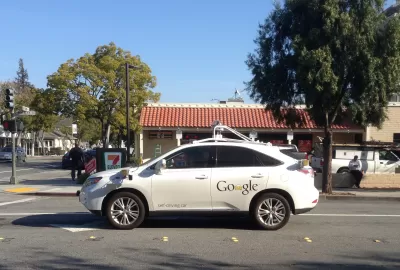
In transportation, many technologies exist as concepts or in niches for a long time before they reach widespread adoption. Timothy B. Lee suggests that there's reason to expect big changes in the coming years as many of these technologies go mainstream. "According to Bloomberg, battery costs have fallen by 65 percent since 2010," Lee writes for Vox as an example. Changes in battery costs will be big drivers in changes for the overall affordability of electric vehicles.
Another transit technology that seems to be coming is delivery drones (both flying and grounded): "Rolling food delivery robots have already started to show up on the sidewalks of San Francisco and other cities." Whether these drones will be allowed to share sidewalks with people is a subject up for debate. Autonomous vehicles, which are on the minds of companies like Uber, Tesla and Google, could also change trucking, and many startups are already dedicated to this very industry. "Initially, these trucks will handle highway driving with a human driver on hand to handle unexpected situations. But, eventually, software will likely replace human drivers altogether," Lee reports.
Read the full story: 9 radical changes that are coming to transportation

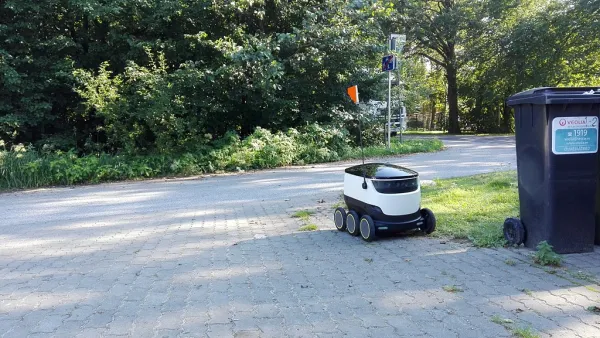
Delivery Robots Get Legal Status in Washington, D.C.
A delivery drone pilot launched in Washington, D.C. in 2016 has been expanded for further deployment.

Swapping your gas car for an EV is greener than keeping it, research shows
An EV repays the 'carbon debt' caused by building it after 4,400 miles.
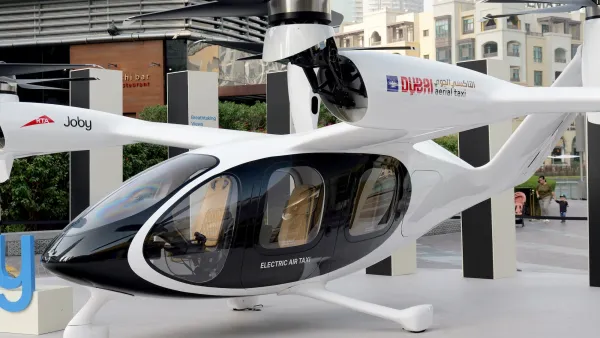
Florida wants to shift its entire EV charger budget to air taxi 'vertiports'
FDOT argues the private sector is already building out the state's fast-charging infrastructure, so the state could redirect those funds elsewhere.

Planetizen Federal Action Tracker
A weekly monitor of how Trump’s orders and actions are impacting planners and planning in America.

California plans to bury El Niño’s downpour
If the state plays its cards right, it may be able to store a billion acre-feet of El Niño’s water in aquifers.

Chicago breaks ground on $3 billion megadevelopment
The new neighborhood, titled Foundry Park, will one day host 3,700 residences.

California High-Speed Rail Authority CEO resigns after $600,000 scandal
Under Ian Choudri, the authority used taxpayer dollars to fund first class flights and trips to nightclubs.

Want to study the Missouri River? Soon, you may need unanimous approval from 10 states
Legislation would require 10 governors’ permission to study or build projects moving water outside the basin.

Desperate measures: Advocates weigh draining Lake Powell to fill Colorado River
Draining the reservoir could reduce evaporation losses by a couple hundred thousand acre-feet.

FREE Course: Walkable City 1: Why Walkability?
After describing his path towards focusing on walkability as the essence of good planning, Jeff Speck marches through his five principal reasons for making more walkable places.
Reinventing Malls: Planning Alchemy—Turning Gray Fields Into Gold
The course focuses on the opportunities and imperatives that shape reinvention of mall sites.

City of Rosemead
Rutgers University, Edward J. Bloustein School of Planning and Public Policy
One Hundred Miles
Hunter College, City University of New York (CUNY)
The Architects Foundation
University of Cincinnati Online
City of Cambridge
Montrose County
The Pocatello Development Authority