The city of Berkeley is suffering the consequences of the urban revival—soaring housing costs and humanitarian crises don't reconcile with the city's famously progressive politics.


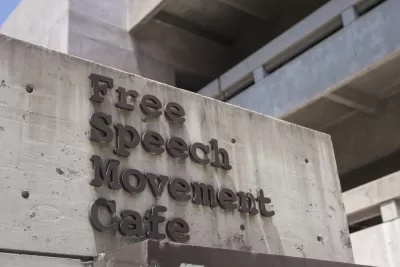
Four homeless people have died in the city of Berkeley, California in recent months, challenging "Berkeley’s idea of itself as a bastion of progressive and humanitarian values," according to an article by Rob Waters.
According to that premise, Berkeley's famously left-wing values are clashing with "unyielding economic realities. While upscale restaurants and apartment developments are common, "median rents have soared more than 40% in the past three years, to $3,483 a month," according to data from Zillow. "Meanwhile the homeless population has grown from 680 in 2009 to probably more than 1,000 today," adds Waters. "Strikingly, this is around 1% of the city’s population."
Waters then takes readers on a tour of the ongoing back and froth between "anti-homeless" legislation proposed by the city and the political backlash that usually arises in response. Recently a progressive majority was elected to power at the Berkeley City Council with the promise of change. Since then, the "city set up an emergency operations center to coordinate crisis housing and opened a 47-bed winter shelter, for instance." But, according to Waters, those actions have sparked opposition from some residents, who argue more services will draw more homeless people to the city.
FULL STORY: Berkeley's liberal image in question amid homeless crisis: 'The soul of our city is at stake'


Lack of Multi-Family Zones Contributes to Nashville’s High Housing Costs, Study Says
Nashville and surrounding communities allow for a relatively small amount of multi-family housing, according to a new zoning atlas of Middle Tennessee. A regionally focused nonprofit is using the atlas to push for zoning reforms.
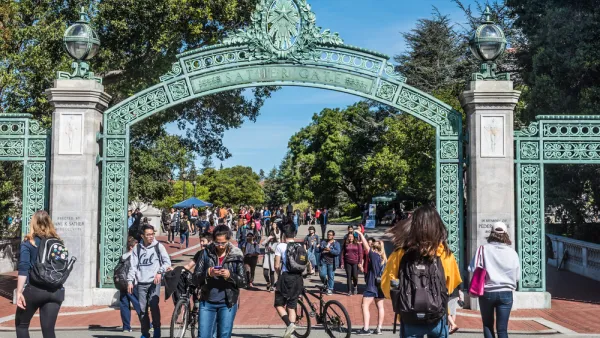
Without New Environmental Impact Report, UC Berkeley Will Enroll Thousands Fewer Students
A high-profile example of the power of the California Environmental Quality Act (CEQA) might cause thousands of students to miss out on a chance to attend the University of California, Berkeley.
Judge Caps Enrollment at UC Berkeley Pending Environmental Impact Report
An Alameda County judge dealt a stunning rebuke of a plan to expand the campus of the University of California, Berkeley, with housing and new space for the Goodman School of Public Policy.

Planetizen Federal Action Tracker
A weekly monitor of how Trump’s orders and actions are impacting planners and planning in America.

The state-sanctioned urbicide of Austin
People don’t kill cities. Freeways do.

US to reduce Colorado River water deliveries to Mexico
A new Colorado Treaty amendment reduces Mexico’s Colorado River water allocation by 250,000 acre feet.

Baltimore to break ground on $50 million Transit Priority Project
The project will bring faster bus trips, safer streets and better bike connections to Baltimore.

Airbnb launches $250 million 'last-dollar financing' housing accelerator, makes first investment in Austin
The company will put $6.4 million towards affordable housing development in Texas’ capital.

Guerilla urbanists are building DIY bus stop benches in Chicago
A before-and-after of one of the bus stops with a new bench. The new benches are not officially sanctioned or permitted, but the residents who placed them hope they will be the start of a network of DIY benches across the city.

FREE Course: Walkable City 1: Why Walkability?
After describing his path towards focusing on walkability as the essence of good planning, Jeff Speck marches through his five principal reasons for making more walkable places.
Reinventing Malls: Planning Alchemy—Turning Gray Fields Into Gold
The course focuses on the opportunities and imperatives that shape reinvention of mall sites.

Eagle County Government
Harvard University Graduate School of Design
Nashville Planning Department
The Architects Foundation
University of Cincinnati Online
The Pocatello Development Authority
The Urban Renewal Agency of the City of Pocatello
Journal of the American Planning Association