The critical turning point for the Los Angeles County Metropolitan Transportation Authority's naming rights proposal can be summed up by an old adage: beggars can't be choosers.



"Two months after approving a controversial policy to sell naming rights to Los Angeles County’s subway stations, bus stops and other transit properties, transportation officials have overturned the plan, citing legal concerns," reports Laura J. Nelson.
The Metropolitan Transportation Authority’s board of directors voted to repeal the policy Thursday after receiving guidance from a staff attorney, who said that refusing a sponsorship deal because of a company’s business practices or political affiliation could expose Metro to lawsuits.
County Supervisors Sheila Kuehl is quoted in the article summing up the results of that legal concern: "As it turns out, we can’t really pick and choose." The idea was proposed to raise revenue to address the Metro transit system's operating deficit, which persists despite the strong fiscal health for the agency in the wake of Measure M's $120 billion infusion in transportation funding.
Read the full story: Transit officials backtrack on controversial policy to sell naming rights for Metro stations


L.A.'s San Fernando Valley $909 Million Closer to Light Rail
The last time rail transit crossed L.A.'s San Fernando Valley was in the early 1950s.
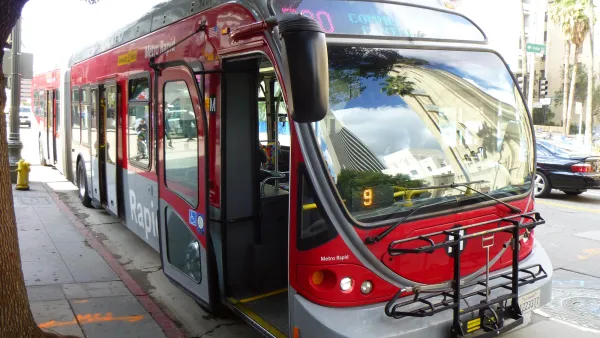
L.A. Metro Will Pilot Free Fares for Most Riders
The Los Angeles County Metropolitan Transportation Authority will let low-income residents and K-12 students ride for free starting in January 2022.

Los Angeles Needs New Funding Sources to Meet Public Transit Ambitions
With an aggressive plan to build out numerous public transit lines in time for the 2028 Olympics, local officials are scrambling to fill funding gaps as prices continue to rise and catch planners and officials by surprise.

Planetizen Federal Action Tracker
A weekly monitor of how Trump’s orders and actions are impacting planners and planning in America.

Data reveals that NYC’s bet on congestion pricing has paid off
After almost two years of the program, reports show positive impacts on traffic and air quality and no disruptions to parking.

HUD modernizes 50-year-old manufactured housing framework
The Next Generation Manufactured Housing Action Plan establishes new energy-efficiency standards for manufactured homes, and new guidelines for anchoring them.

Florida could lose billions in funding for infrastructure, parks
If Amendment 3 passes, Miami-Dade would lose about $445 million annually by fiscal year 2028-29.

New Mexico spent millions drafting climate goals. Data centers are unraveling them
Three data centers in New Mexico and El Paso will release more emissions yearly than 2 million cars in the same timeframe.

This Ohio town is using AI to speed up transit analysis
The Greater Dayton Regional Transit Authority’s new AI tool correctly determined riders’ preferred ways to reach key commuter routes.

FREE Course: Walkable City 1: Why Walkability?
After describing his path towards focusing on walkability as the essence of good planning, Jeff Speck marches through his five principal reasons for making more walkable places.
Reinventing Malls: Planning Alchemy—Turning Gray Fields Into Gold
The course focuses on the opportunities and imperatives that shape reinvention of mall sites.

Rutgers University, Edward J. Bloustein School of Planning and Public Policy
One Hundred Miles
County of Mendocino
The Architects Foundation
University of Cincinnati Online
Montrose County
Northern Illinois Transit Authority (NITA)
The Pocatello Development Authority